


KitchenAid KF2 review: good coffee for people who don’t have time to make it properly
I ran KitchenAid’s entry-level automatic machine through a month of rushed mornings and iced coffee orders, to see whether one-touch coffee can really be that quick.
If your mornings don’t leave room for grinding, tamping or steaming milk by feel, the KF2 removes most of that admin. Pour beans into the hopper, pick a drink, and the machine handles grinding and dosing on its own, no measuring, no guesswork. It’s genuinely fast once it’s set up, and the espresso it pulls is properly good. The catch, especially if iced coffee is your daily order, is that the default settings need a small tweak before the machine gets it right. The over-ice setting comes out weak until you nudge the strength up, and the steam wand, while excellent, still needs you to stand there and pour. None of this takes more than a few extra seconds once you’ve found your settings, but it’s not quite the single-tap coffee some rivals promise straight out of the box.
Quick specs
| Price | £699 / $799.99 / AU$1,099 |
| Weight | 10.1kg |
| Dimensions | 36.1cm H x 19.6cm W x 47cm D |
| Drink options | 6, including espresso, coffee and over ice |
| Grind settings | 5 |
| Capacity | 250g bean hopper, 250g ground coffee |
| Water tank | 1.8 litres |
| Material | Stainless steel and matte black |
What it costs, and where it sits in the range
The KF2 is priced at £699 in the UK, $799.99 in the US and AU$1,099 in Australia, which makes it the entry point into KitchenAid’s new compact lineup. Above it sit the KF3 at £749 and the KF4 at £899, both of which trade the KF2’s manual steam wand for a fully automated milk system. In other words, KitchenAid has built the choice around exactly the trade-off a busy morning forces on you: pay more and hand milk over to the machine entirely, or keep the wand and spend a few extra seconds getting better results by hand. For anyone who mostly drinks black coffee, iced or otherwise, that makes the KF2 the sensible starting point rather than a compromise.
Built for a counter, not a barista station
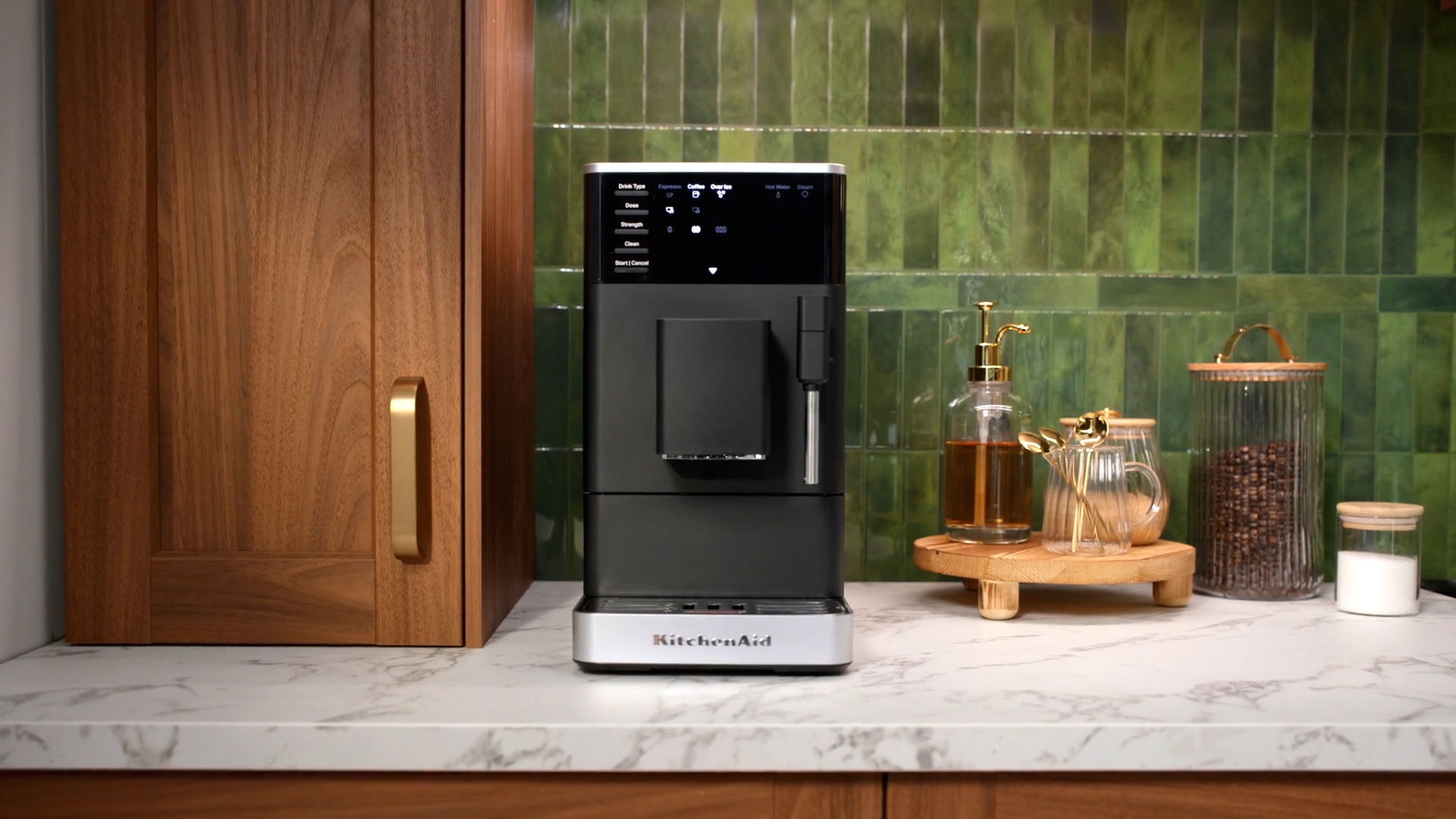
KitchenAid has shrunk this new range down considerably compared with its older machines, and the KF2 shows it. At 36.1cm tall and just 19.6cm wide, it barely eats into counter space, which matters if your kitchen wasn’t designed with a bean-to-cup machine in mind. Controls sit on five function buttons beside a small backlit screen, with a power button on the side, a 1.8-litre water tank at the back, and a 250g bean hopper tucked out of sight.
Two wheels underneath make it easy to slide the whole thing forward for topping up water without lifting it, and at 10.1kg it’s light enough to reposition on your own if needed. The finish is matte black only. It’s smart rather than flashy, though anyone hoping for the white or green options available further up KitchenAid’s range will need to spend more to get them.
The grinder that means you never have to think about it again
This is where the “no time” pitch really lands. KitchenAid’s Intelligrind system reads your beans and sets the grind automatically, so the entire routine is pour beans in, pick a drink, walk away. There’s a manual slider behind a side panel if you want to fine-tune things, but I never felt the need to touch it. The grinder is also Quiet Mark certified, so it won’t wake anyone else up if six a.m. is your only quiet window.
For context, on the manual espresso machine I normally use, getting from beans to a drinkable cup involves weighing a dose, grinding it, tamping it and adjusting for how the puck looks before you even hit brew, easily two or three minutes if you’re not rushing. On the KF2 that entire process happens while you’re still reaching for a mug. It’s the single biggest reason this machine suits someone who wants proper coffee but doesn’t have the morning to spare for it.
The one wrinkle is the ground coffee compartment, useful if you keep decaf on hand, but the machine defaults to it over your beans the moment you add any, and you have to manually switch back each time. It’s a small thing, but if speed is the whole point, it’s the sort of setting worth remembering so it doesn’t catch you out on a groggy morning.
Dialling in your order once, then never again
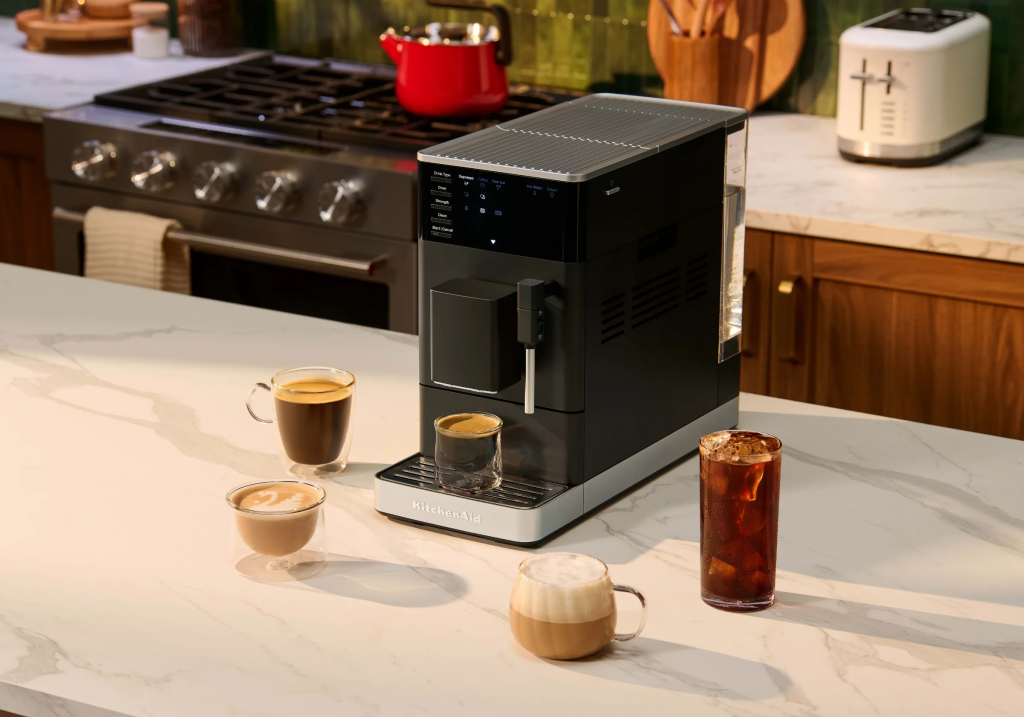
Strength and dose are both adjustable, and the machine grinds a different amount, between roughly 7g and 14g, depending on what you choose. The first coffee I pulled took a bit of trial and error: my first americano at triple strength was far too much, and it took a second attempt at double strength to land somewhere sensible. That’s the honest trade-off with a machine this customisable. It asks for a few minutes of tweaking early on.
I ran the same test with a straight espresso a few days later, this time starting at the machine’s default strength rather than guessing high. That first shot needed no correction at all, thick, glossy crema and a well-balanced extraction straight away, which suggests the dial-in period matters more for milk-based and iced drinks than for a simple black espresso. If your order is a straightforward flat white or espresso rather than something more involved, you may not need to adjust anything before it’s right.
The upside for anyone actually short on time is that this only has to happen once per drink type. Once you’ve found your settings for your usual order, the KF2 remembers them, and every coffee after that really is a single button press. The espresso itself, once dialled in, was consistently well extracted with a thick, stable crema, which is more than a lot of machines at this price manage straight out of the box.
The one part that still needs your hands

Unlike the KF3 and KF4, which use a hose-based automatic milk system, the KF2 sticks with a traditional Pannarello steam wand, and you’ll need to buy your own milk jug separately. That’s a genuine time cost each morning, you’re pouring, steaming and pouring again rather than pressing one button and walking off. But the payoff is better milk. In back-to-back testing, the KF2’s steamed milk had noticeably tighter, glossier microfoam than the automatic systems on its siblings, which produced milk that was silky but far less textured.
It’s also the better option if you drink plant-based milk, since you can watch and feel the temperature as it heats and pull it off before it scalds, something a fully automatic system can’t judge for you. I ran this test deliberately with oat milk, which splits and turns grainy well before dairy does if you overheat it. Keeping the wand just below the surface and pulling it off the moment the jug felt properly warm rather than hot gave a smooth, foamy result every time, something I couldn’t reliably manage on the KF3’s automatic system during a side-by-side test. A side toggle adjusts foam from minimal to full, so a flat white and a latte are both achievable without much guesswork once you know which setting you want.
Iced coffee: the real test
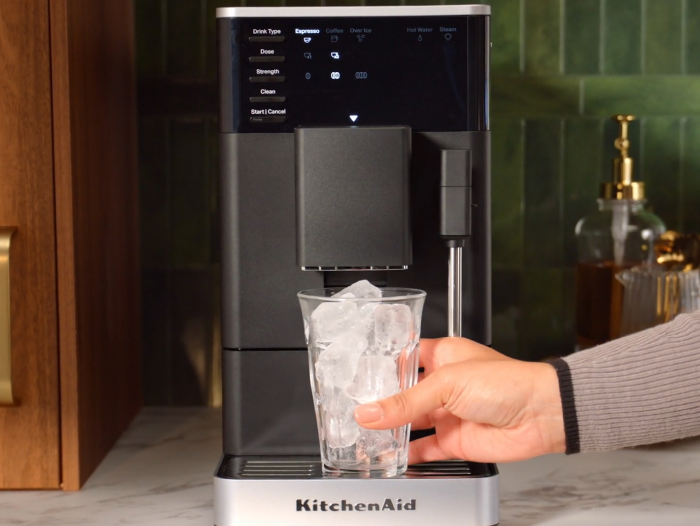
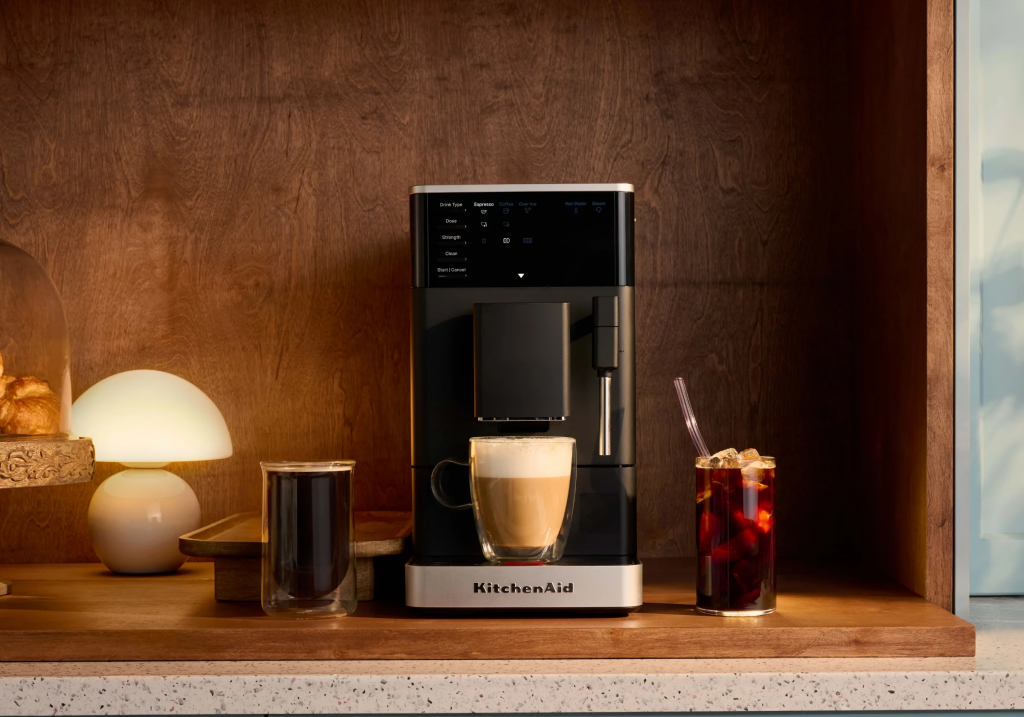
Iced coffee is where the KF2‘s automation gets genuinely tested, and it’s the part of this review most worth reading carefully if that’s your usual order. The machine’s over-ice setting works by pulling a cooler shot directly over ice already in your cup, rather than brewing a concentrated shot separately and chilling it. The first one I made came out noticeably weak, since the ice starts melting the moment hot-ish espresso hits it, diluting the drink before you’ve even added milk.
The fix is straightforward but not obvious until you hit the problem: bump the strength setting up from the machine’s default, or brew into a separate cup and pour over fresh ice yourself rather than brewing directly onto ice that’s already sitting there. Once I’d made that adjustment, iced lattes and iced americanos both came out properly balanced rather than watery, and repeating the same settings each morning took no extra thought at all.
I tested this specifically on mornings where I genuinely didn’t have time to fuss, packing a school bag with one hand and hitting the drink preset with the other. Once the strength setting was saved, the whole process from pressing the button to walking out the door with a finished iced latte took under a minute, ice, milk and all. That’s the real payoff of the early trial and error: the effort is front-loaded once, then the machine carries the rest of your mornings for you.
If you’re someone who wants a genuinely one-touch iced coffee without ever having to think about strength, this is worth knowing before you buy. It’s not that the KF2 can’t do it well, it clearly can, but it needs that one small correction first, which cuts against the completely hands-off promise of a fully automatic machine.
Maintenance that mostly runs itself
Day to day upkeep is minimal. The machine rinses itself before and after every use, which also warms the internal pipework so your first coffee isn’t lukewarm. The drip tray flags when it needs emptying, and the screen alerts you when beans are running low, so there’s little guesswork involved in keeping it running.
Two cleaning tablets and a water filter insertion tool come in the box, and KitchenAid says filters last around two months on tap water or up to six months on filtered water. Descaling solution is sold separately, and the machine will prompt you when it’s needed. None of this ate into an actual morning during testing, the rinse cycles happen automatically while you wait for your cup, and the only maintenance that needs scheduling around your day is the occasional filter swap, which takes under a minute. I didn’t have to descale mine during testing, but the alert system inspires enough confidence that I’m not worried about missing it. KitchenAid backs the KF2 with a three-year limited warranty.
Is the KitchenAid KF2 worth it if you’re short on time?
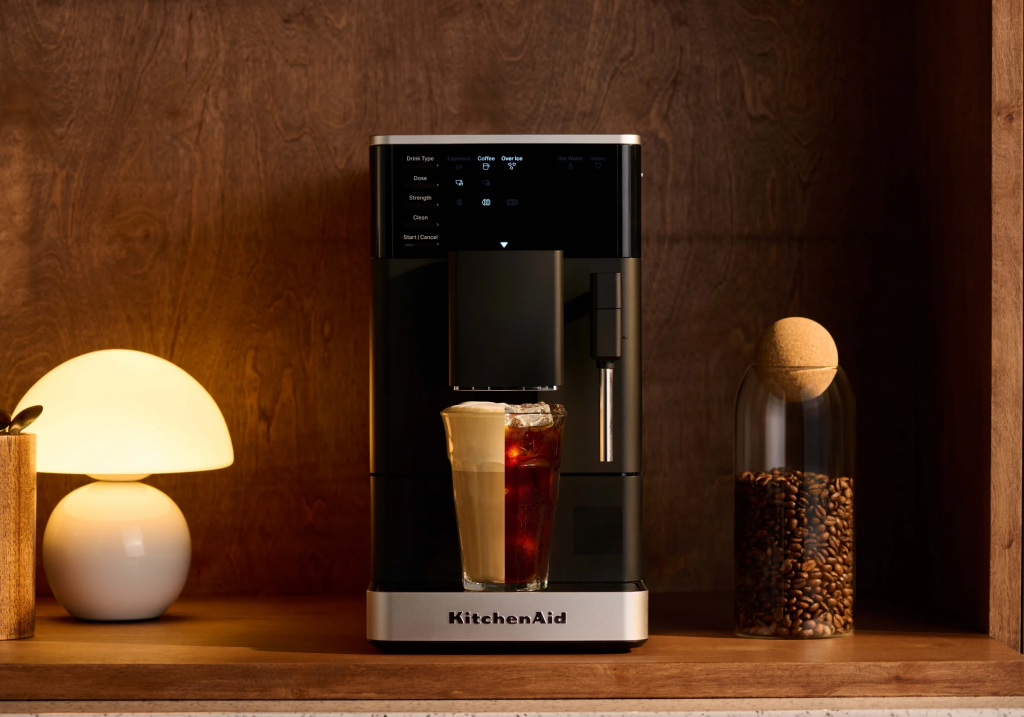
For anyone who wants proper coffee without the ritual of grinding, tamping and dialling in an espresso machine by hand, the KF2 delivers that in every sense that matters. The grinding and dosing genuinely are one-touch, the espresso is consistently good, and once you’ve found your settings for your usual order, the whole routine takes barely longer than a pod machine.
Where it falls short of true zero-effort is milk and iced coffee, both of which need a small amount of manual input, pouring and steaming for the former, a strength tweak for the latter, before they’re right. Neither is a big ask, and both become second nature after the first week, but if you want a machine that gets milk-based and iced drinks correct on the very first try with zero adjustment, it’s worth looking at the alternatives below instead.
If you’re happy to spend thirty seconds with a steam wand in exchange for noticeably better milk texture, and don’t mind tuning your iced coffee once before it becomes routine, the KF2 is one of the best automatic machines at this price for someone whose mornings don’t have room to spare. If, on the other hand, you want to press one button and get a finished iced latte correctly on the very first try, every time, with zero setup, it’s worth spending a bit more or looking at one of the alternatives below.
Also worth a look
If you want milk handled entirely by the machine, the KitchenAid KF3 is the natural step up at £749. Its AutoMilk system froths and pours with no manual steaming at all, though it’s worth noting it doesn’t handle iced coffee quite as confidently as the KF2 does once you’ve adjusted the strength, so weigh that trade-off if iced drinks are a daily habit.
If cost matters as much as convenience, the Ninja Luxe Café is worth a look at £549.99 RRP, and it regularly turns up closer to £450 in sales. It pairs an automatic milk frother with a dedicated cold brew setting rather than KitchenAid’s over-ice method, which sidesteps the dilution issue entirely and makes it arguably the more genuinely hands-off choice for anyone whose order is mostly iced.