


AeroBand Guitar Review: A Brilliantly Weird Music-Tech Hybrid
Let’s address the obvious question right away: is the AeroBand Guitar a toy or a real instrument?
The answer is yes.
And that’s exactly why it’s interesting.
The AeroBand Guitar sits in a strange but fascinating space between traditional instruments and modern music gadgets. It’s not trying to replace your Strat, your Tele, or your beloved acoustic. It’s not pretending to be a “real guitar” in the purist sense. Instead, it’s doing something far more modern and far more honest: it’s rethinking when, where, and how you can play guitar in a world that doesn’t always leave room for amps, pedals, tuning, or even time.
After spending proper time with it, one thing is clear: this isn’t a gimmick. It’s a clever, surprisingly capable, and genuinely fun piece of music tech that scratches an itch most guitarists didn’t even realise they had.
First Impressions: This Is Not What You Expect
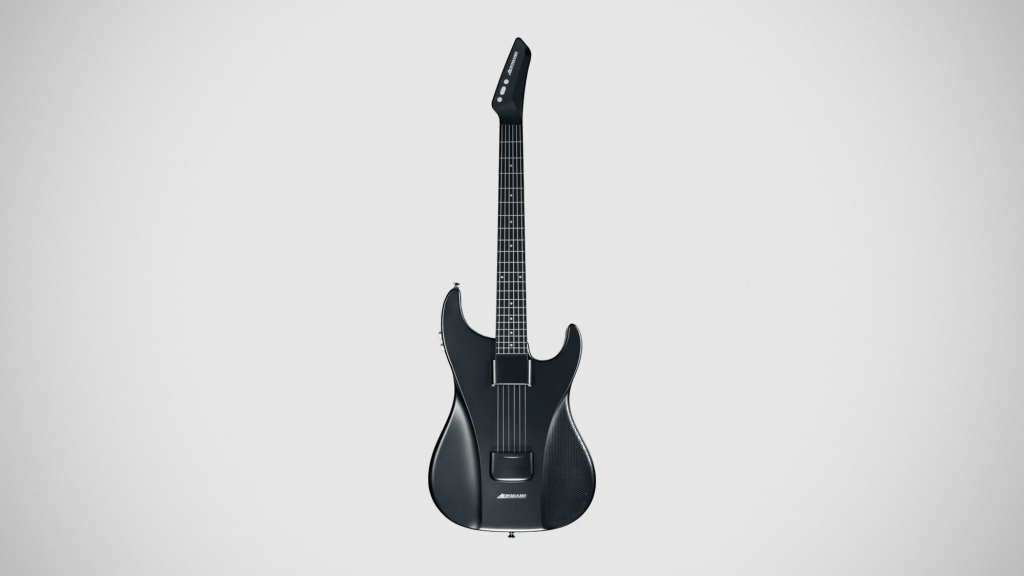
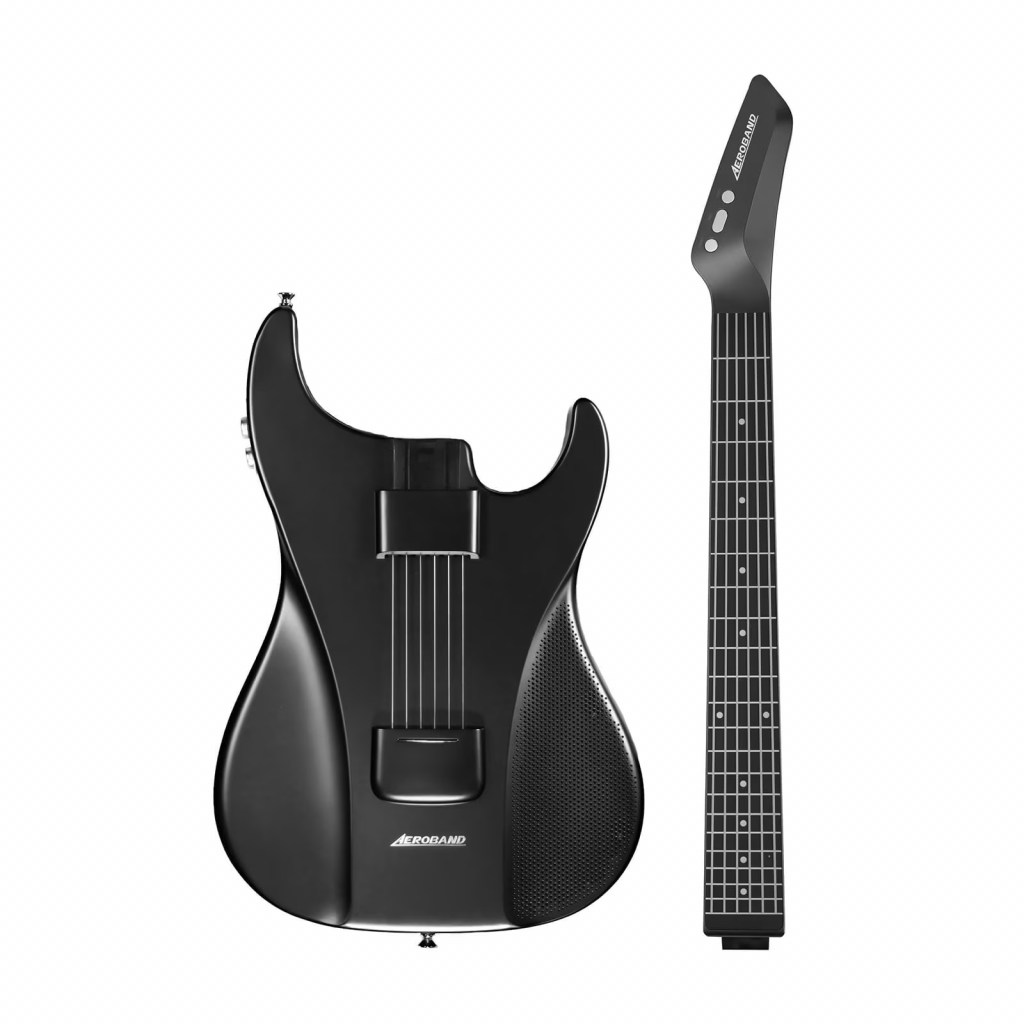
When you first pick up the AeroBand Guitar, your brain immediately starts categorising it. The body is compact. The neck is detachable. The strings feel… different. And yet, it doesn’t feel cheap, plasticky, or disposable.
This thing feels engineered.
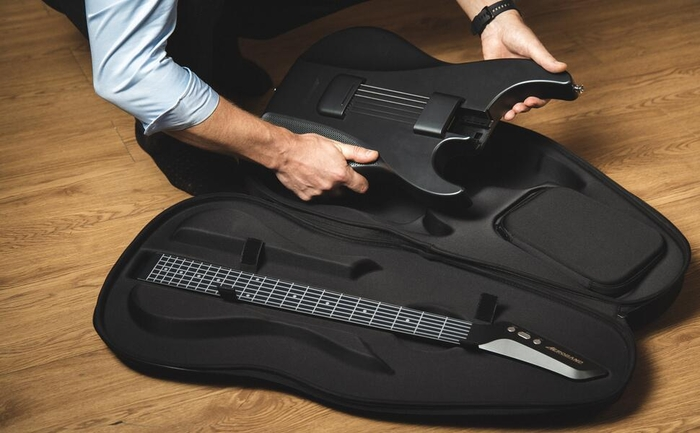
The tactile strings give you a real strumming surface, while the neck is packed with sensors that track finger placement instead of relying on traditional frets. It’s clearly built with intent, not novelty. The whole device collapses down into something that fits easily into a backpack, which already tells you what AeroBand is aiming for: portability without killing creativity.
It’s lightweight, quick to assemble, and ready to play in seconds. No tuning. No cables everywhere. No “wait, where’s my pedal power supply?”
That alone makes it feel refreshing.
How It Actually Works (And Why That’s Cool)
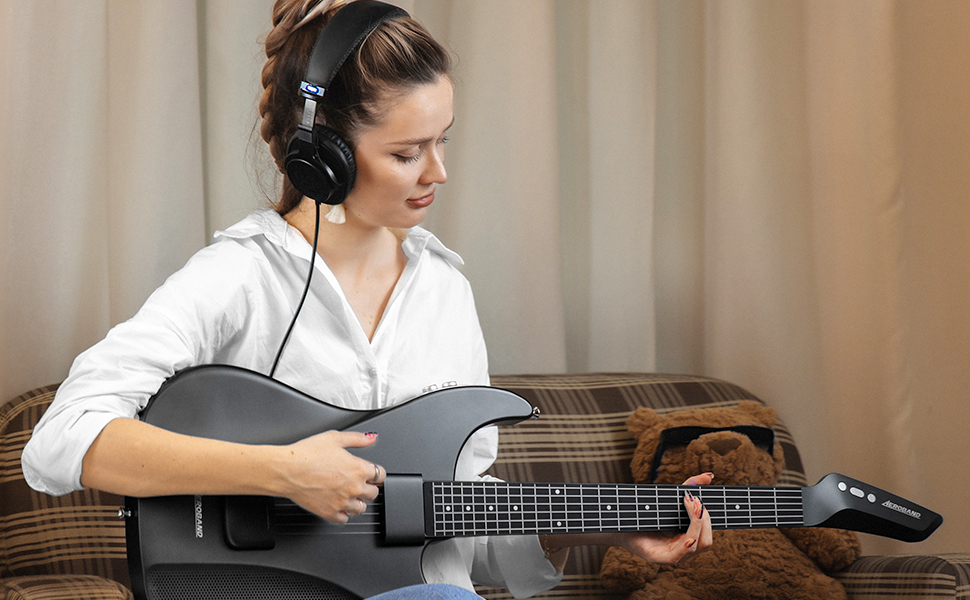
The AeroBand Guitar uses a mix of motion sensors, touch-sensitive fret zones, and digital sound processing to translate your movements into music. Your strumming hand interacts with physical strings, while your fretting hand works against sensor pads instead of metal frets.
That means the guitar can detect chords, single notes, and transitions without requiring the physical tension of real strings. You’re essentially playing a hybrid of physical input and digital interpretation.
And here’s the nerdy part: this opens up possibilities that traditional guitars simply don’t have.
You can drop octaves instantly.
You can switch between guitar and bass vibes without changing instruments.
You can experiment with built-in effects without pedals.
You can play silently with headphones or through speakers without an amp.
From a music-tech perspective, that’s genuinely exciting.
Playability: Familiar Enough, Different Enough
Let’s be clear, this will not fool your fingers into thinking you’re playing a real guitar. If that’s your expectation, you’ll be disappointed. The AeroBand doesn’t fight physics, and it doesn’t pretend to.
Instead, it meets you halfway.
Chord playing feels natural surprisingly quickly. Basic progressions, rhythm work, and casual strumming are intuitive and satisfying. For noodling, songwriting sketches, or warming up your musical brain, it works extremely well.
Lead playing is where the difference becomes more obvious. The fret sensors have a slightly grippy, rubberised feel, which means sliding isn’t as fluid as on metal strings. Fast runs, bends, and expressive lead lines feel a little disconnected. There’s also less tactile feedback overall, which makes precision playing feel more abstract.
That said, this isn’t a failure, it’s a trade-off. AeroBand clearly prioritised accessibility and portability over perfectly emulating string physics. And for its intended use, that makes sense.
Latency: Yes, It Exists; No, It’s Not a Dealbreaker
If you’re extremely sensitive to latency, you will notice a slight delay between finger movement and sound output. It’s not dramatic, and it won’t ruin casual play, but it’s there.
For rhythm playing and experimentation, it fades into the background. For fast lead work or very tight timing, it becomes more noticeable. Traditional electric guitars still win here, no question.
But context matters. This is not a studio replacement. It’s a creative tool, a practice companion, and a travel-friendly instrument. Judged on those terms, the latency is acceptable and rarely intrusive.
Where the AeroBand Truly Shines: Convenience and Creativity

This is where the AeroBand Guitar earns its place.
It’s the guitar you pick up between meetings.
The guitar you play on a hotel bed.
The guitar you grab when you have five minutes of creative energy but not an hour to commit.
There’s something incredibly satisfying about being able to play without setup friction. No tuning. No plugging in. No noise complaints. Just pick it up and go.
The built-in effects add another layer of fun. Dropping an octave and pretending you’re a bass player? Surprisingly addictive. Switching tones without pedals? Liberating. Experimenting without consequence? Inspiring.
This thing encourages play, not perfection, and that’s a powerful mindset for musicians.
Who This Is Actually For (And Who It Isn’t)
The AeroBand Guitar makes the most sense for a very specific type of user, and that’s a good thing.
It’s excellent for beginners who are curious about guitar but intimidated by traditional instruments. The reduced physical strain and instant feedback make learning feel less punishing.
It’s genuinely useful for guitarists recovering from injury or dealing with grip strength issues. Being able to play without string tension is a big deal.
It’s perfect for musicians who travel often and want something lightweight that doesn’t feel like a compromise.
And it’s catnip for tech-savvy musicians who love experimenting with new tools and new ways of making music.
What it is not is a replacement for a real guitar. It won’t replace your main instrument, your studio setup, or your live rig. And it doesn’t try to.
Build Quality and Design: Thoughtful, Not Gimmicky
From a hardware perspective, the AeroBand feels well-built. The detachable neck mechanism is solid. The body doesn’t creak or flex. Buttons and controls feel intentional, not toy-like.
This matters, because the moment something like this feels flimsy, the illusion collapses. AeroBand avoids that trap. The design communicates that this is a serious product, even if it doesn’t take itself too seriously.
It feels like a device made by people who understand musicians, not just engineers chasing novelty.
Price Reality: The Only Real Sticking Point
At around $400+, the AeroBand Guitar lives in an awkward pricing zone. It’s too expensive to be an impulse gadget and too unconventional to justify itself purely on specs.
Would most people buy this instead of a traditional guitar at that price? Probably not.
Would most people be thrilled to receive it as a gift? Absolutely.
This feels like a product that makes more emotional sense than logical sense. And honestly, that’s not a bad thing. Music is emotional. Creativity is emotional. Not every purchase needs to be optimised for resale value or long-term ROI.
Final Verdict: A Clever, Joyful, Slightly Weird Win
The AeroBand Guitar is one of those products that makes you smile because it shouldn’t work as well as it does, but it does.
It’s not perfect. It’s not traditional. It’s not for everyone.
But it’s clever, fun, and genuinely useful in a way that many music gadgets never achieve. It fills a niche that didn’t really exist before and does it with confidence.
If you’re looking for a portable creative outlet, a low-friction way to stay musically engaged, or a tech-forward instrument that encourages experimentation, the AeroBand Guitar earns its place.
It’s not trying to replace guitars.
It’s trying to make playing more accessible.
And on that front, it absolutely succeeds.