



XGIMI Horizon 20 Max review: a 5,700-lumen daylight cinema that wants £2,599 of your money
XGIMI’s flagship triple-laser projector is bright enough to take on a sunny living room, but the price puts it in seriously rarefied company.
As an Amazon Associate we earn from qualifying purchases.
A note on how we’ve approached this: we haven’t had the Horizon 20 Max in for hands-on testing, so this review is built on XGIMI’s published specs, confirmed UK pricing and what the hardware promises on paper. Read our score as a spec-sheet verdict, not a lab result.
Most projectors have the same dirty secret. They look glorious at midnight with the curtains drawn, then fall apart the second someone opens the blinds. The XGIMI Horizon 20 Max exists to fix that. It’s the brightest model in the Horizon 20 family, built around an RGB triple-laser engine rated at 5,700 ISO lumens, and it’s clearly aimed at people who want a proper big screen without turning the lounge into a bunker.
The catch is the sticker. At £2,599 it costs more than plenty of OLED TVs, so the real question is whether all that light is worth the money. We think it can be, for the right buyer.
The verdict in brief
The Horizon 20 Max is the projector to buy if your room is never properly dark. The triple-laser engine, Dolby Vision and IMAX Enhanced support, wide lens shift and genuinely low gaming latency add up to one of the most complete packages in its class. It loses points for the missing 4K 120Hz mode, the lack of Dolby Atmos and a price that makes its cheaper siblings look very tempting. Buy it for daylight movies and sport. Skip it if you only watch after dark.
Pros and cons
What we like
- 5,700 ISO lumens from an RGB triple-laser engine, well clear of the Horizon 20 Pro (4,100) and the base Horizon 20 (3,200)
- Dolby Vision, HDR10+, HLG and IMAX Enhanced support, with up to 110% BT.2020 colour coverage claimed
- Optical zoom, wide lens shift, auto keystone and obstacle avoidance make setup forgiving
- Quoted input lag of 3ms at 4K 60Hz and 1ms at 1080p 240Hz, with VRR and ALLM
What we don’t
- £2,599 is a lot, and the Pro model gets you most of the way there for less
- No true 4K 120Hz mode, which stings for PS5 and Xbox Series X owners
- At 5.4kg with no built-in battery, “portable” means room to room, not rucksack
- Dolby Audio support, but no Dolby Atmos
Key specs
- Price: £2,599 (UK)
- Light source: X-Master RGB triple laser, DLP, 0.47-inch DMD chip
- Brightness: 5,700 ISO lumens
- Resolution: 3,840 x 2,160 (4K UHD)
- HDR: Dolby Vision, HDR10+, HDR10, HLG, IMAX Enhanced
- Screen size: 40 to 300 inches, 1.2 to 1.5:1 throw ratio
- Processor: MediaTek 9679 SoC, Google TV, Wi-Fi 6, Bluetooth 5.2
- Audio: 2 x 12W Harman Kardon speakers, DTS Virtual:X, Dolby Audio
- Ports: 2 x HDMI (one eARC), USB 3.0, USB 2.0, optical out, 3.5mm out
- Gaming: 1ms at 1080p 240Hz, 2.2ms at 1080p 120Hz, 3ms at 4K 60Hz
- Size and weight: 249 x 298 x 190mm, 5.4kg
Price and availability
XGIMI launched the Horizon 20 range in October 2025, with the Max sitting at the top of a three-model line-up. In the UK the Horizon 20 Max costs £2,599, and we confirmed that exact figure on XGIMI’s own UK store as well as in stock on Amazon UK at the time of writing. XGIMI does run promotions, so it’s worth checking both before you pay full whack.
The cheaper options are the Horizon 20 Pro and the base Horizon 20. They share the same core feature set, and the main difference is brightness, which is the whole point of paying more for the Max.
Design and build
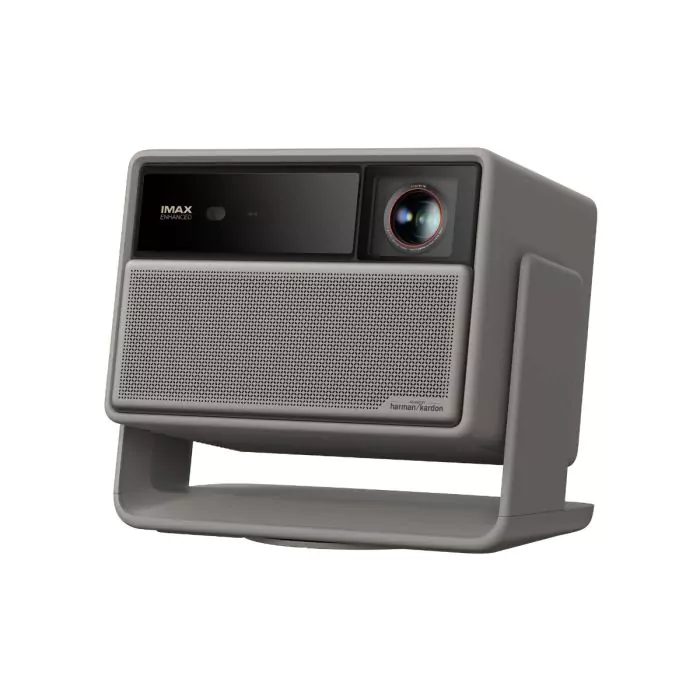
The Horizon 20 Max is built like a small piece of living room furniture rather than a gadget you stash in a cupboard. It has a grey, leather-look finish, a built-in hinged stand to adjust projection height and a standard 1/4-inch thread underneath, so you can bolt it to a floor stand or ceiling mount if you’d rather get it off the coffee table. XGIMI quotes fan noise of 28dB in eco mode, which should keep it from dominating quiet scenes.
The size is the trade-off. At 249 x 298 x 190mm and 5.4kg, this isn’t a projector you tuck into a bag for the garden. If that’s the lifestyle you’re after, our XGIMI Elfin Flip review covers a far more compact option.
Where the Max earns its keep is setup. Optical zoom and a wide lens shift range mean you can park it where it suits the room and then line the picture up with the screen, rather than contorting the furniture. Auto keystone, auto focus, obstacle avoidance and wall colour adaptation do the fiddly bits for you. On paper, that’s one of the friendliest installs you’ll find at this price.
Picture quality
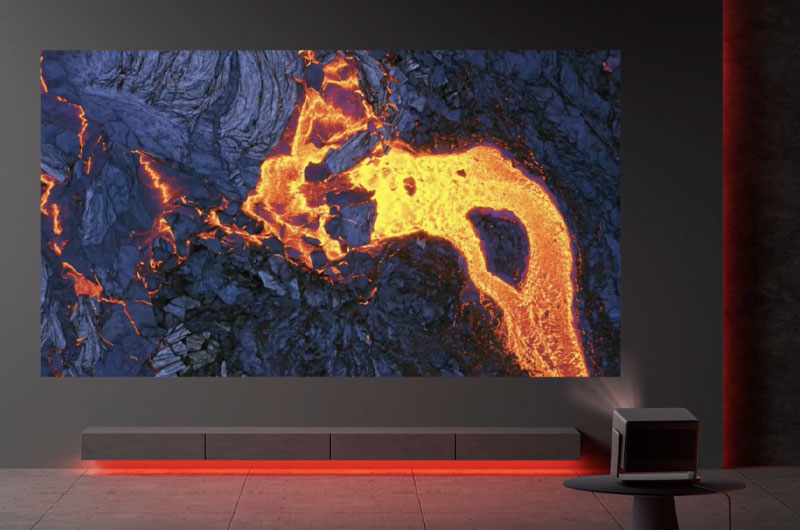
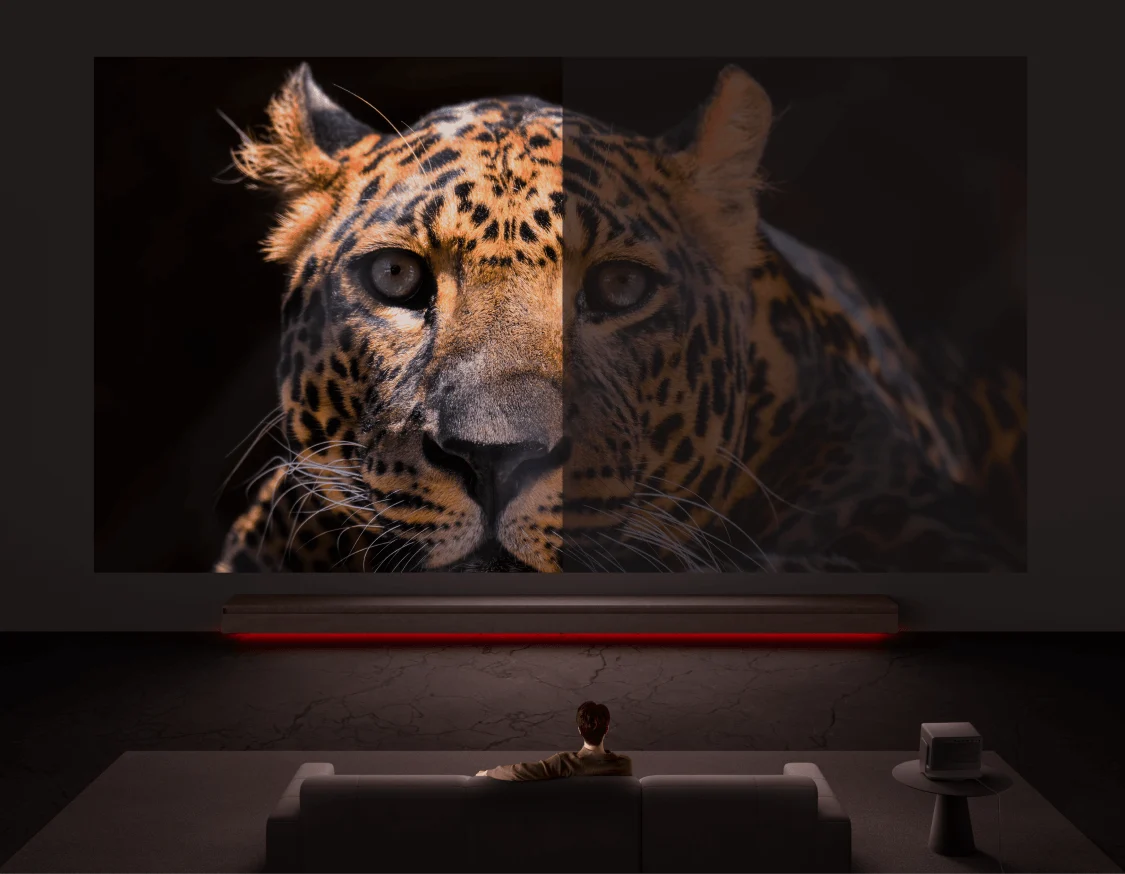
This is the headline act. The RGB triple-laser engine drives red, green and blue lasers separately instead of leaning on a single white light source, which is how XGIMI claims up to 110% BT.2020 coverage and a 20,000:1 contrast ratio with its dynamic contrast mode switched on. Treat that contrast number with the usual caution, as dynamic figures are always flattering, but the colour pitch is the sort of thing you’d expect to make animation and sport look properly vivid.
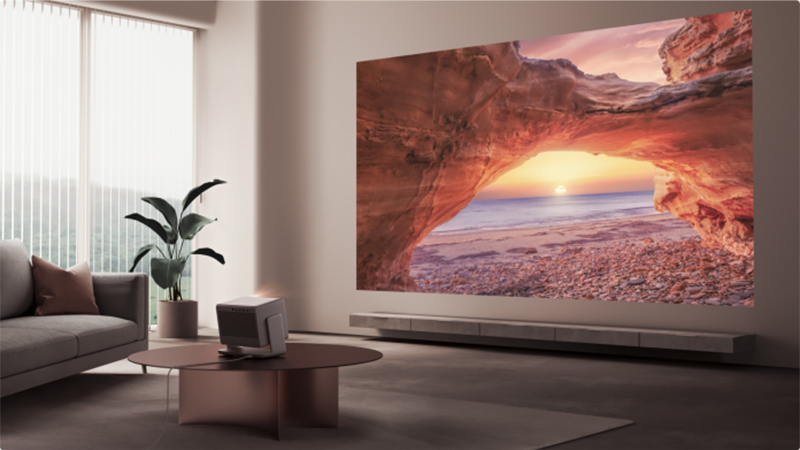
Brightness is where it separates from the pack. 5,700 ISO lumens is a seriously high number for a home projector, and it’s why we think this is the one for lounges with big windows. If you’ve ever tried to watch a Saturday afternoon match on a projector with the curtains open, you’ll know why that matters. It’s also a natural fit if you’re building a sports setup, as in our guide to turning your home into a World Cup viewing den.
Format support is excellent. You get Dolby Vision, HDR10+, HDR10 and HLG, plus IMAX Enhanced certification and a Filmmaker Mode setting. There’s MEMC motion smoothing, AI upscaling for lower-resolution content and 3D support if anyone still owns the glasses. One caveat: the 0.47-inch DMD chip means 4K arrives via pixel shifting, as it does on most DLP projectors in this class, so purists shouldn’t expect native 4K panels.
Sound
Two 12W speakers tuned by Harman Kardon sit inside, along with DTS Virtual:X processing and Dolby Audio decoding. That should be plenty for a casual evening or Saturday football. For proper movie night punch you’ll want a soundbar or AV receiver, and the HDMI eARC port gives you a clean route to one. The missing Dolby Atmos support is a shame at this price, but it’s a quibble rather than a deal-breaker.
Gaming
The numbers are strong. XGIMI quotes 3ms input lag at 4K 60Hz, 2.2ms at 1080p 120Hz and 1ms at 1080p 240Hz, backed by VRR and ALLM. For fast shooters and racing games, that’s the kind of responsiveness you normally associate with a gaming monitor, not a big-screen projector.
The disappointment is the absence of a proper 4K 120Hz mode. If you own a PS5 or Xbox Series X and want the very best frame rates at full resolution, you’ll be choosing between 4K at 60Hz or 1080p at 120Hz. That’s a fair compromise for most people, but it’s a notable omission on a flagship.
Software and smarts
Google TV is built in, with licensed Netflix and the usual streaming apps, so you can skip the dongle entirely. A MediaTek 9679 processor and Wi-Fi 6 keep things quick, and Bluetooth 5.2 lets you pair a speaker or headphones. Google TV is a sensible choice, as it’s familiar, well supported and easy to navigate with the remote.
Our take
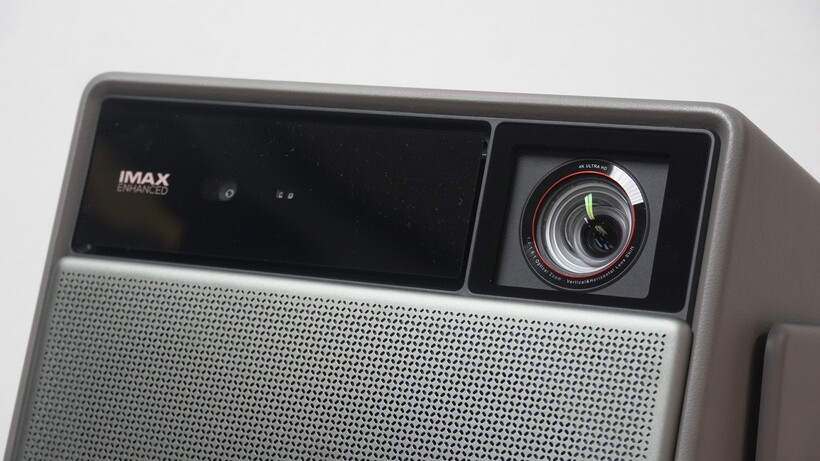
The Horizon 20 Max is a brilliant answer to a specific question: what do you buy when your room isn’t dark and your standards are high? Its brightness, flexible installation and low latency make it one of the most capable projectors you can buy for a living room. It isn’t perfect. The missing 4K 120Hz mode and Dolby Atmos are real gaps, and the price demands commitment.
Buy it if you watch films, sport and games in a bright room and want a big, punchy picture without blackout blinds. Don’t buy it if you only watch in the dark, because the Horizon 20 Pro will do the job for noticeably less. And if you’d rather have a TV, our Samsung S99H review shows how far Mini-LED brightness has come.
Also consider
- Anker Nebula X1: a triple-laser rival in the same price bracket, worth a look if you prefer Anker’s ecosystem and optional external speakers.
- Hisense C2 Ultra: a sleeker, slightly more compact triple-laser alternative if outright brightness matters less to you.
- Valerion VisionMaster Pro 2: another bright 4K triple-laser projector, but less portable, so best for a permanent home cinema.
- Epson EF-72: if you’d rather read about a cinema-first alternative, our Epson EF-72 review is a good place to start.
Ready to buy? Buy the XGIMI Horizon 20 Max on Amazon UK or see it at XGIMI UK.