


Jabra Just Admitted One Headset Can’t Do Everything, So It Built Three More
Jabra has expanded its Evolve3 professional headset range with three new models built around a simple idea: the headset that suits a noisy open-plan office is not the same headset that suits someone working from a coffee shop three days a week. The Evolve3 65 Flex, Evolve3 65 and Evolve3 45 land globally in September 2026, and together they mark Jabra’s clearest attempt yet to move away from the one-size-fits-all headset that most offices have been quietly tolerating for years.
It is a shift that makes more sense the longer you sit with it. Hybrid working has scattered people across kitchen tables, hot desks and packed open-plan floors, and a headset tuned for one of those environments tends to struggle in the others. Jabra’s own research backs that up, with the company finding that 73% of employees struggle to hear other participants in hybrid meetings. That is not a small usability niggle. It is the kind of friction that quietly drags down every call, every stand-up and every voice memo a team relies on.
Three Headsets, Three Very Different Jobs

Rather than iterating on a single flagship, Jabra has built each new model around a specific way of working. The Evolve3 65 Flex is the one for people who move around. It ditches the traditional boom-arm microphone entirely in favour of a foldable, pocket-sized design, and leans on AI-powered voice isolation to cut through wind and street noise instead. It is aimed squarely at the same crowd who made the Evolve2 65 Flex Jabra’s most portable professional headset, and on paper it looks like a meaningful step up, with adaptive four-mic ANC and up to 16 hours of talk time.
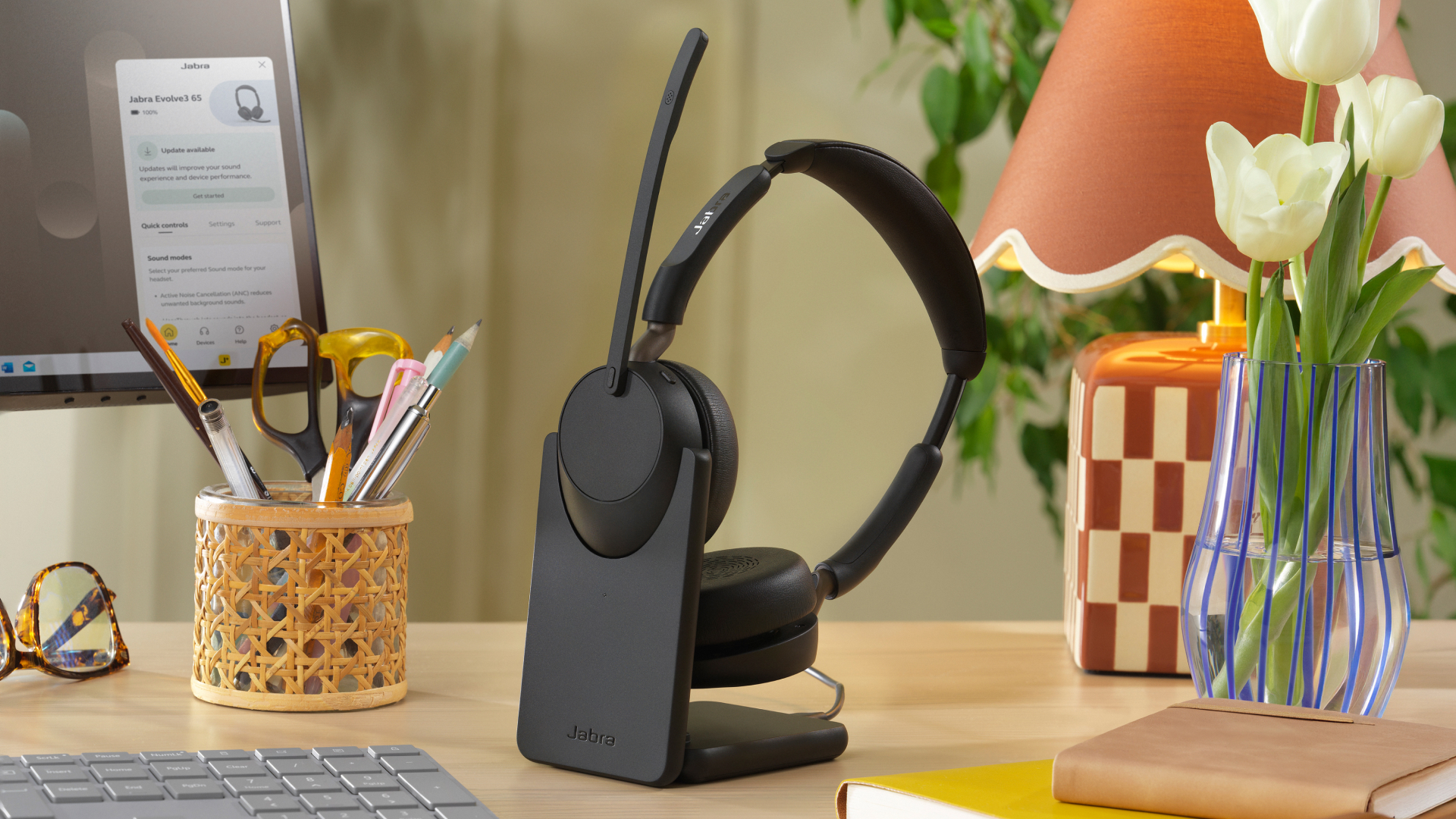
The Evolve3 65 takes the opposite approach. It keeps a proper boom arm and leans into three-mic ClearVoice pickup, positioning itself as the default pick for busy open-plan offices where the real challenge is drowning out the desk next door rather than the wind outside. Battery life here is the standout spec, with Jabra quoting up to 31 hours of talk time, comfortably enough for a full working week without reaching for the charger.
Then there is the Evolve3 45, the lightest on-ear model in the range at around 100g. This one is not trying to do anything clever. It is built for people who are mostly sat at a desk taking call after call, and it prioritises comfort and simplicity over the more advanced adaptive features found on its siblings. At £173, it is also the cheapest way into the new range.
All three sit underneath the existing Evolve3 75 and Evolve3 85, launched earlier this year for the most demanding call environments, and together the five models now form a full replacement for the Evolve2 line that has been in production since 2020. For any IT team that has been quietly patching together mismatched headsets across a hybrid workforce, that is the more meaningful headline here: a structured upgrade path rather than another single device to shoehorn into every role.
Built With AI Tools In Mind, Not Just Human Ears
The bit that separates this launch from a routine headset refresh is how openly Jabra is designing around AI. Every model in the new range is tuned not just for human listeners on the other end of a call, but for the transcription and summarisation tools increasingly sitting on top of meetings. Jabra claims over 99% voice pickup accuracy for AI tools in open-office environments on the Evolve3 65, dropping slightly to over 95% on the more exposed Evolve3 65 Flex.
It is a sign of where workplace audio is heading. A headset used to only need to sound clear to the person on the other end of the call. Now it also needs to feed clean audio into a speech-to-text engine that is quietly generating the meeting notes nobody wants to write themselves. Get that pickup wrong and it is not just an annoying crackle anymore, it is a wrong word in an action item that nobody catches until later.
Calum MacDougall, President at Jabra, put the philosophy behind the launch fairly plainly: different roles come with different communication demands, and audio that does not match how someone actually works becomes a productivity problem as much as a comfort one. It is hard to argue with the logic, even if it is also a convenient way to sell three headsets instead of one.
What’s Shared Across The Range

Beneath the differences, all three new models share the same core toolkit. Jabra ClearVoice technology handles the actual noise isolation, in-call ANC reduces background sound for the wearer specifically during conversations rather than just for general focus, and all three connect over secure Bluetooth Low Energy with centralised management through Jabra Plus and Jabra Xpress, so IT teams can deploy and manage them at scale without touching every individual device. They are certified across Microsoft Teams, Zoom and Google Meet, and Jabra has made a point of highlighting replaceable batteries and ear cushions alongside recycled and bio-circular materials, aimed at stretching the usable life of each unit well beyond the usual few years of hard office use.
Pricing And Our Take
The new range lands at £260 for the Evolve3 65 Flex, £220 for the Evolve3 65, and £173 for the Evolve3 45, with all three shipping globally in black from September. That is not cheap for headsets pitched partly at everyday desk callers, and some early reaction online has already questioned whether the step up from the outgoing Evolve2 line justifies the price jump, particularly on the entry-level 45.
Where we think this actually earns its keep is in the structure of the decision it is offering IT buyers, not just the individual specs. Rather than picking a single headset and hoping it survives contact with every workstyle in the building, organisations can now genuinely match the hardware to the person: boom arm and stamina for the open-plan floor, boomless portability for the hybrid crowd, lightweight simplicity for the person glued to their desk. Whether that flexibility is worth the premium will likely come down to how much a business is currently losing to bad call audio and mangled AI transcripts, and for plenty of hybrid teams, that number is higher than they think.