


AeroPress Manual Coffee Grinder review: Hand-grinding finally feels worth the effort
A £199 hand grinder sounds like madness until you see how even the grind is, and AeroPress has squeezed it into a body slim enough to live inside your brewer.
As an Amazon Associate we earn from qualifying purchases.
The AeroPress Manual Coffee Grinder is the most convincing hand grinder I’ve come across for people who love coffee but don’t want a counter full of kit. The grind is remarkably even, the all-metal build feels made to last, and the party trick of nesting inside an AeroPress plunger is properly clever. It also costs £199 / $199.95, and the grind-size system is more fiddly than it should be. Buy it if you brew filter or AeroPress, travel with your coffee gear and hate stale beans. Skip it if espresso is your daily drink or if you’re watching the budget.
Pros and cons
Pros
- Grind consistency that holds its own against far pricier electric burr grinders
- All-metal build with a smooth, bearing-backed handle
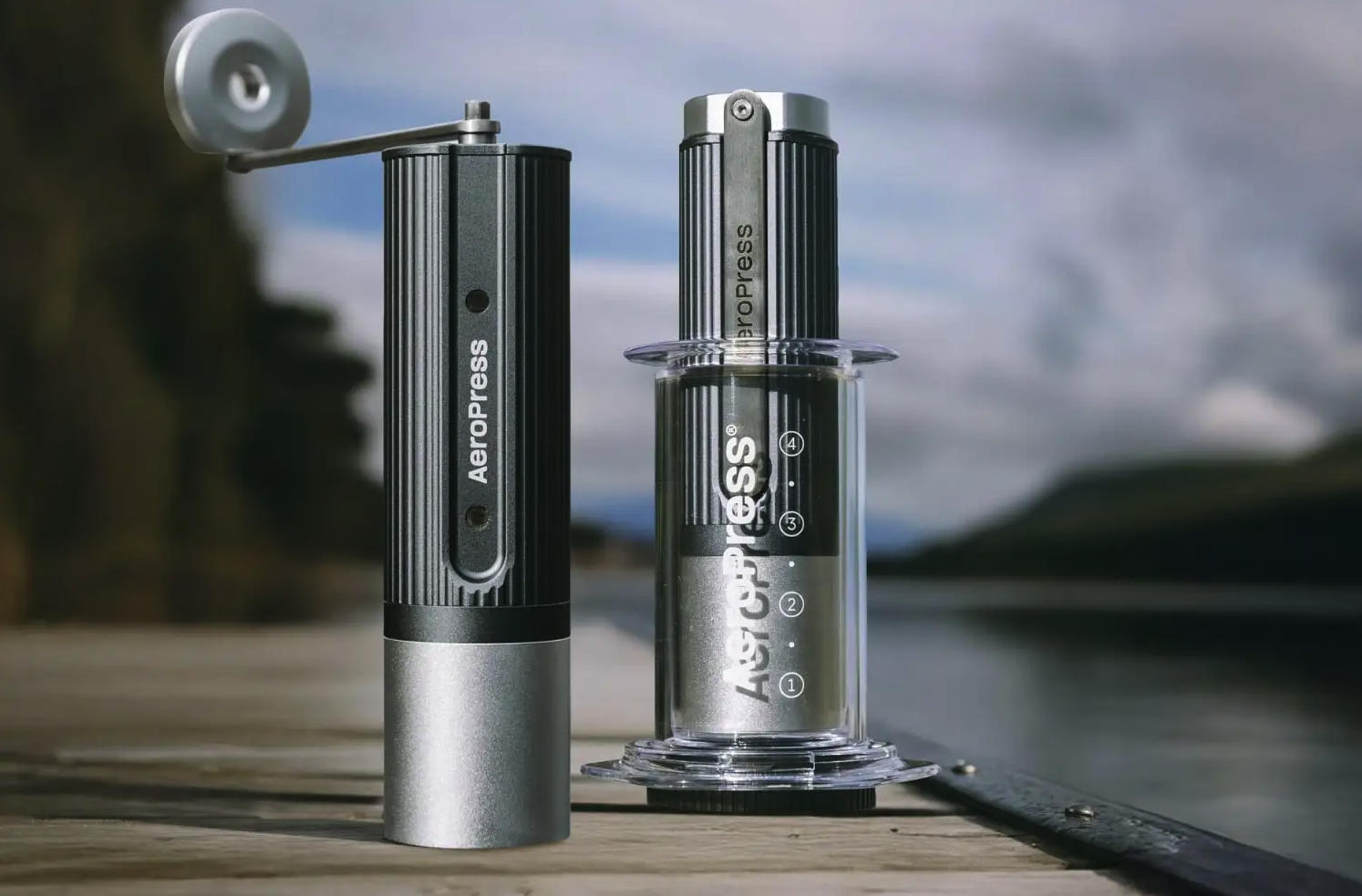
- Magnetic handle and slim body slot into an AeroPress plunger, with a soft pouch for everything else
- Over 60 grind settings, from espresso-fine to cold brew coarse
Cons
- £199 is a lot next to capable rivals
- The rotation-plus-click grind system is confusing, and the suggested espresso setting can choke a machine
- 25g capacity suits one or two cups, not a full house
Quick specs
| Price | £199 (UK) / $199.95 (US) |
| Burrs | 38mm titanium-coated stainless steel conical, made in Italy |
| Grind settings | 60+ (factory preset: rotation 3, click 6, medium-fine) |
| Capacity | 25g |
| Body | Anodised aluminium |
| Weight | Roughly 540g |
| In the box | Magnetic handle, soft carry pouch, two cleaning brushes, power drill adapter |
| Warranty | Lifetime on the burrs, one year on the rest |
| Fits inside | Most AeroPress models (not the AeroPress Premium) |
Why I wanted this to be good
I’m the person who won’t drink coffee that was ground more than a few minutes before it hit the cup. Pre-ground beans taste flat to me within days, and good beans cost too much to waste, which makes the grinder the most important object in my kitchen, more than any brewer. It also explains why I’ve always been wary of hand grinders. Too many of them ask you to trade a sore wrist for a lumpy, uneven grind that makes every cup slightly sour and slightly bitter at the same time.
Price and availability
The grinder launched in November 2025 and costs £199 in the UK and $199.95 in the US. You can buy it direct from AeroPress and from Amazon UK and other select markets, with wider distribution rolling out. Retail discounts do appear around sales events, so check the live price before you buy.
That is a premium price for a hand grinder, and AeroPress knows it: the grinder sits in the brand’s premium range alongside its higher-end brewers rather than with its everyday gear. The question is whether the performance justifies it, and mostly, it does.
Design and build
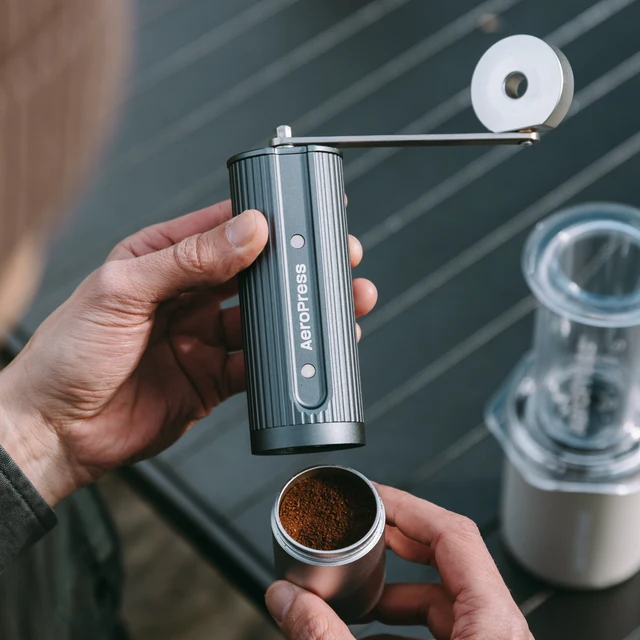
Lift it out of its cushioned box and the first thing you notice is the density. At roughly 540g it is no featherweight, but it feels solid in the way good kitchen tools do. The body is anodised aluminium in a brushed silver that looks more like lab equipment than camping kit, and nothing rattles or flexes. The burrs are the part AeroPress is proudest of: 38mm conical burrs in titanium-coated stainless steel, made in Italy, while the rest of the grinder is assembled in China.
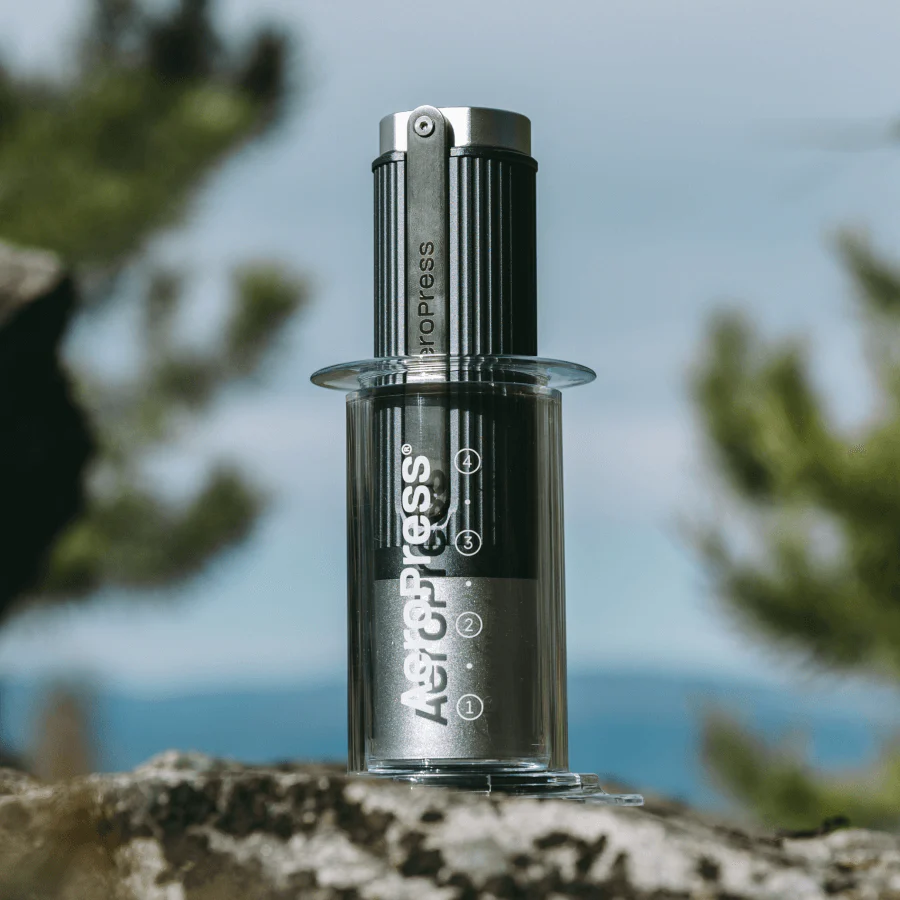
The smartest detail is the handle. It’s magnetic, so it clips flat against the body when you’re done, and the whole grinder then slides into the plunger of an AeroPress. Nothing is loose and nothing jangles in a bag. I’d have loved the same trick with the AeroPress Premium, but it doesn’t fit inside that one.
Twist off the catch cup and you’ll find a gold-toned dial for adjusting the grind. The hopper takes 25g of beans through a wide opening that makes loading easy, enough for one AeroPress or a double espresso. A soft pouch, a dual-ended cleaning brush and a small crevice brush all come in the box. So does a metal adapter that lets you spin the grinder with a power drill, which sounded a bit extreme to me. It could be a godsend for anyone with limited hand strength or mobility, though, and it’s a thoughtful inclusion.
Using it every day
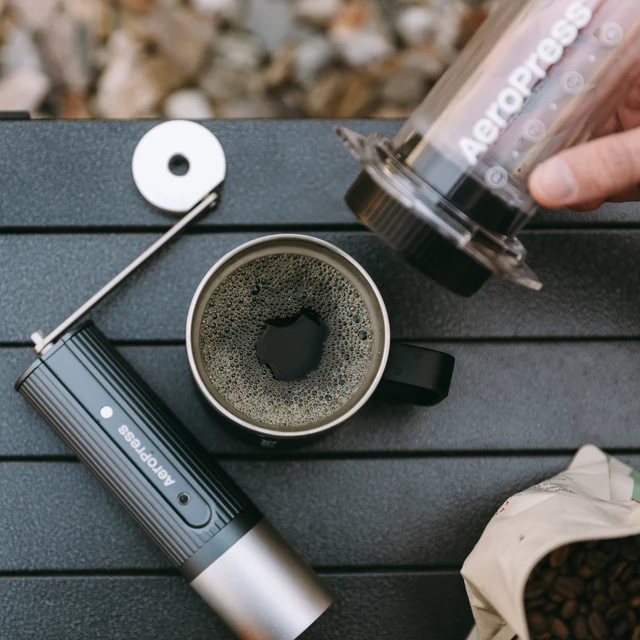
Hand grinding is never completely effortless, and I won’t pretend otherwise. What AeroPress has done is make it comfortable. The handle is large and circular, so pressure spreads across your palm instead of digging into your fingers, and the dual bearings let it rotate smoothly without you having to reposition your grip. Grinding a single AeroPress dose is a short, steady task rather than a workout, and you quickly settle into a rhythm.
A few habits help. Keep the grinder level while you turn it and don’t force the handle, which the manual also advises. Never use frozen beans, as they’re harder and put extra strain on the burrs. Once you’ve got the knack, the morning grind becomes part of the ritual, a minute or two of quiet before the kettle clicks off. For someone who already enjoys the process of making coffee, that’s a feature rather than a chore.
Grind quality: the real reason to buy
This is where the grinder earns its price. Every time I’d open the catch after grinding, the evenness of the grounds was the first thing I noticed. Independent testing backs that up: the grind is consistent enough to sit comfortably alongside much more expensive electric burr grinders, which is not something I can say about most hand grinders, particularly ones this compact.
Why does that matter in the cup? Uneven grounds extract unevenly. Fine particles over-extract and turn bitter while chunky ones under-extract and taste sour, and you get both in the same mug. A tighter spread of particle sizes lets the sweetness and the fruit in a good bean come through without the harsh edges. It’s the difference between coffee that tastes fine and coffee that tastes like the bag promised.
The factory preset is rotation 3, click 6, which is medium-fine and ideal for an AeroPress, so you can brew a good cup straight out of the box. From there you adjust with the dial, and the manual includes a chart for other brew methods.
The grind settings problem
Here is my main complaint. AeroPress counts its grind settings in full rotations of the dial plus clicks, giving you more than 60 positions. In theory that’s wonderful precision. In practice it’s confusing, and I found myself checking the chart more often than I’d like. If the dial spins freely, you aren’t actually adjusting the grind, which is a very easy mistake to make while you’re learning the system.
It matters most for espresso. In lab-style testing, the grinder produced a fine and largely consistent 300 to 500 micrometres, which lines up with standard espresso recommendations. Even so, one tester found that AeroPress’s own suggested setting for espresso choked their machine, so you should treat the printed numbers as a starting point and expect to dial in by taste and shot time. Keep a note of the setting you land on for each bean and each brew method, and the system becomes much less intimidating.
For travel and camping
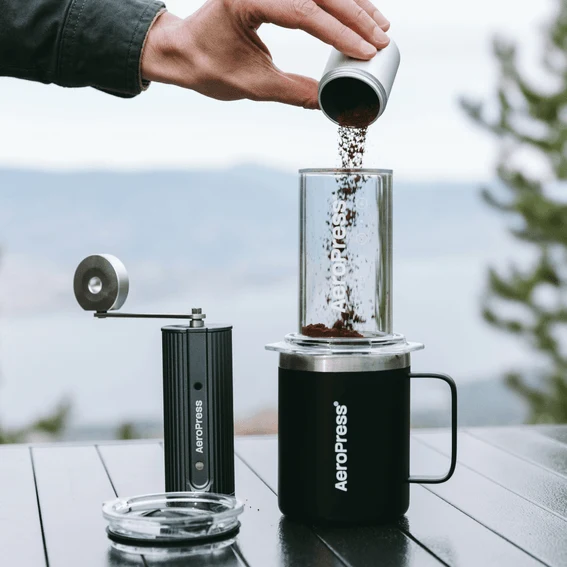
This is where the grinder is at its best. Pack your AeroPress, drop the grinder inside the plunger, add a bag of beans and you have a complete, genuinely good coffee setup in a space not much bigger than a water bottle. It is not light enough for ultralight backpacking, but for car camping, picnics, hotel rooms and holiday rentals it’s ideal. Rental kitchens are not known for their coffee equipment, and the pouch keeps everything tidy.
The 25g catch is the limit. It’s enough for one or two cups, so if you’re making coffee for a group, you’ll be grinding in batches. For a solo traveller or a couple, it’s no problem at all.
Cleaning and upkeep
A quick sweep with the dual-ended brush clears stray grounds from the catch and off the burrs. The grinder unscrews so you can reach the burrs without tools, and keeping them clean keeps them turning smoothly. The burrs carry a lifetime warranty for normal use and the rest of the grinder gets one year, which is reassuring at this price.
Is it worth £199?
Not for everybody. If you simply want a good hand grinder for filter coffee and don’t care about travel, you can spend considerably less and get excellent results. What you’re paying for here is the combination: top-tier grind consistency, a premium metal build, genuine portability and the AeroPress ecosystem fit. For AeroPress devotees who travel, that package is hard to beat. For everyone else, it’s a luxury, and I say that as someone who loves a good luxury.
Also consider
Timemore Chestnut C3S Pro: A far cheaper option with a foldable handle that does a very good job on filter and pour-over. If your budget is tight and you rarely brew espresso, start here. Espresso fans should look at the finer-stepped C3 ESP Pro.
1Zpresso K-Ultra: A favourite premium all-rounder with fine 20 micron adjustment steps. It’s the grinder to choose if espresso is your priority. One tester reports that 1Zpresso doesn’t currently sell replacement burrs for it, so check that before you commit.
Comandante C40 MK4: The long-time cult classic, with a wooden handle, a minimalist look and 39mm burrs, loved by pour-over fans. It’s the one to pick if you value the look and heritage over portability tricks.
1Zpresso Q: The closest rival for travellers. Its 38mm steel burrs and compact body also fit inside an AeroPress plunger, although it holds a little less (20g) and the aluminium and wood body is a different style.
The final word
I went into this review expecting to roll my eyes at a pricey gadget from a brand known for being affordable. I came out of it a convert. The AeroPress Manual Coffee Grinder makes a genuinely even grind, feels built to outlive its warranty and solves a real travel problem with a bit of magnetic cleverness.
It isn’t perfect. The grind-setting system needs a better design, espresso takes some patience, and £199 is a serious sum for something you turn by hand. But if you love your coffee and your morning ritual, that price buys you a grinder you’ll actually enjoy using, and that’s rarer than it sounds.
Buy it if you brew with an AeroPress, filter or pour-over, travel often and care about freshness.
Skip it if espresso is your everyday drink, or if a cheaper grinder would do the job