




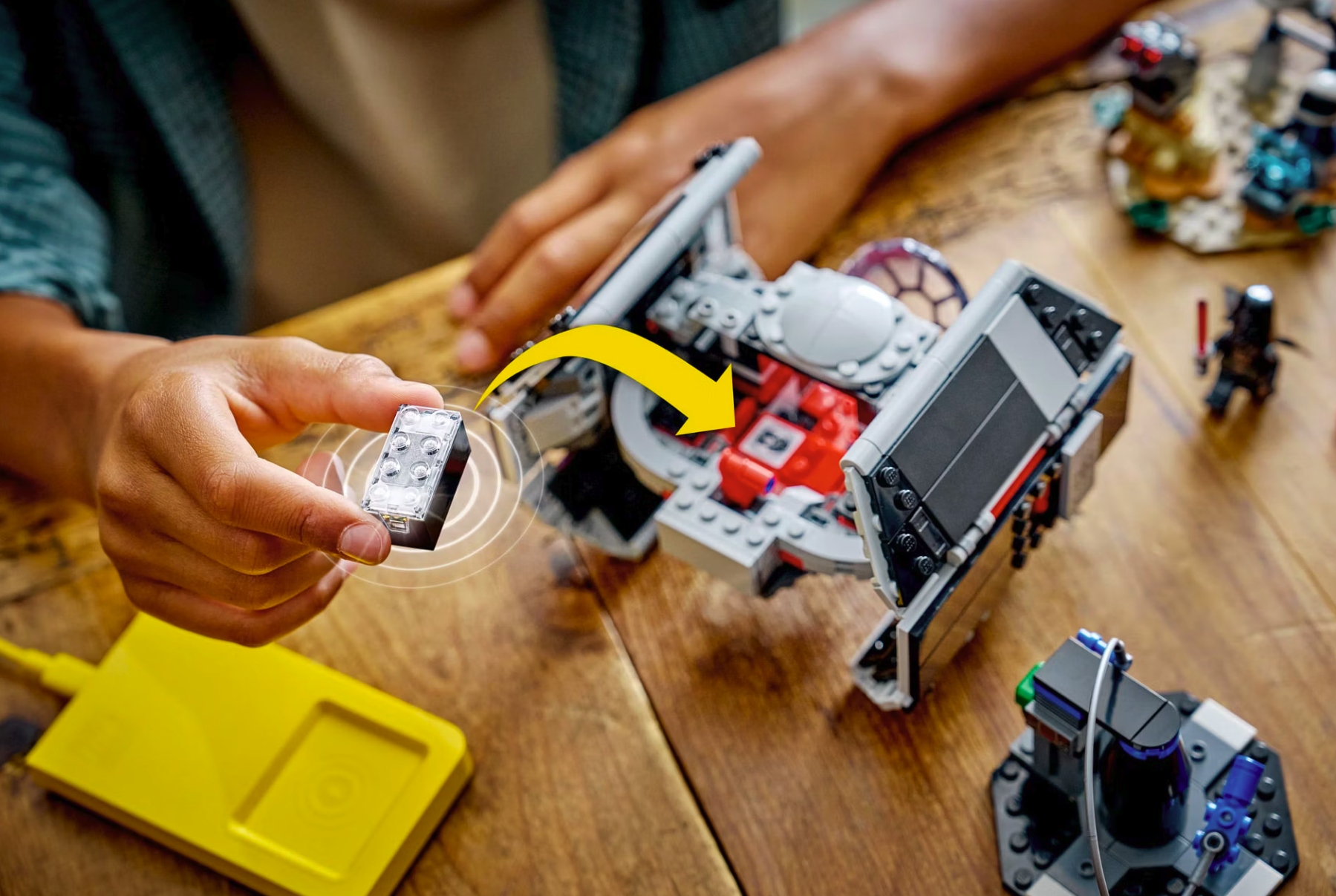
Lego Smart Brick review: a bold step that almost redefines how Lego play feels
There is something genuinely intriguing about the Lego Smart Brick, not because it tries to completely reinvent Lego, but because it subtly reshapes how interaction works without losing the essence of what made the system iconic in the first place, which is far more difficult to achieve than simply adding lights, sounds, and sensors to a toy.
Lego has always thrived on imagination, on the idea that a handful of plastic bricks can become anything depending on who is building and how they choose to play, and introducing technology into that equation carries an obvious risk, because the moment the experience becomes too guided or too dependent on predefined interactions, the freedom that defines Lego begins to fade.
What makes the Smart Brick interesting is that it largely avoids that trap, choosing instead to respond to play rather than dictate it, which becomes clear quite quickly when experiencing it through the LEGO Star Wars 75421 SMART Play: Darth Vader’s TIE Fighter set, a product that feels carefully designed to introduce this new concept without overwhelming it.
A set that introduces the idea without overcomplicating it
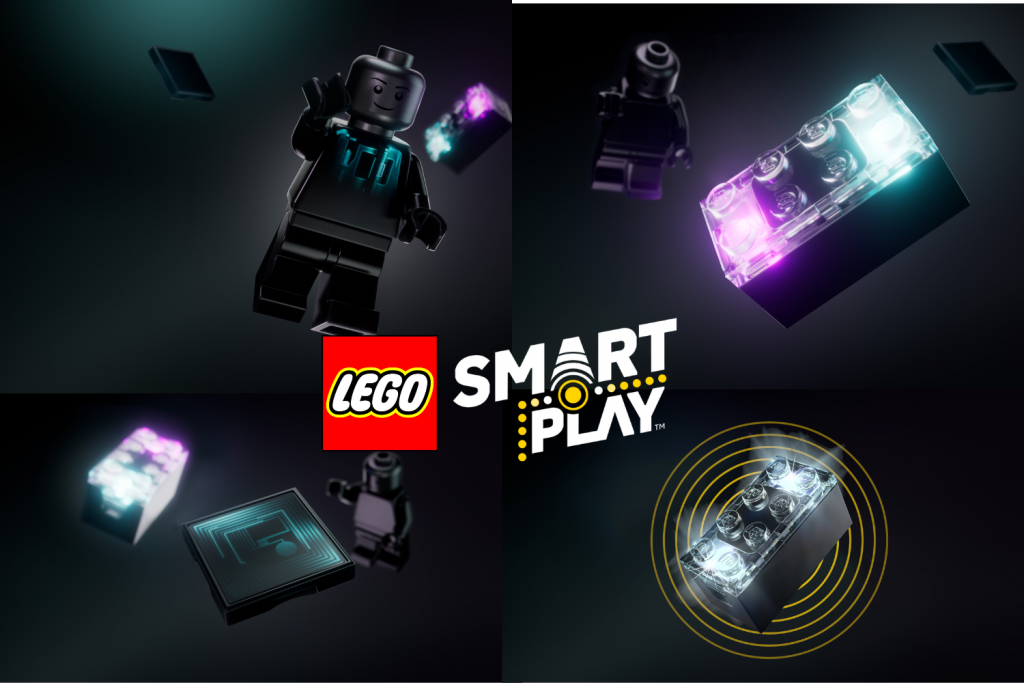
The Darth Vader TIE Fighter set functions as a complete entry point into the Smart Play ecosystem, bringing together the Smart Brick, a Smart Tag, a Smart Minifigure, and a wireless charging solution within a single, cohesive playset that does not require additional purchases to make sense of the system.
That decision matters more than it might initially seem, because it allows the concept to be understood through interaction rather than explanation, which is exactly how Lego works best.
Once assembled, the presence of the Smart Brick immediately changes the character of the build, not by transforming it into something entirely new, but by adding layers of responsiveness that react to movement, orientation, and proximity in ways that feel connected to the physical actions already taking place.
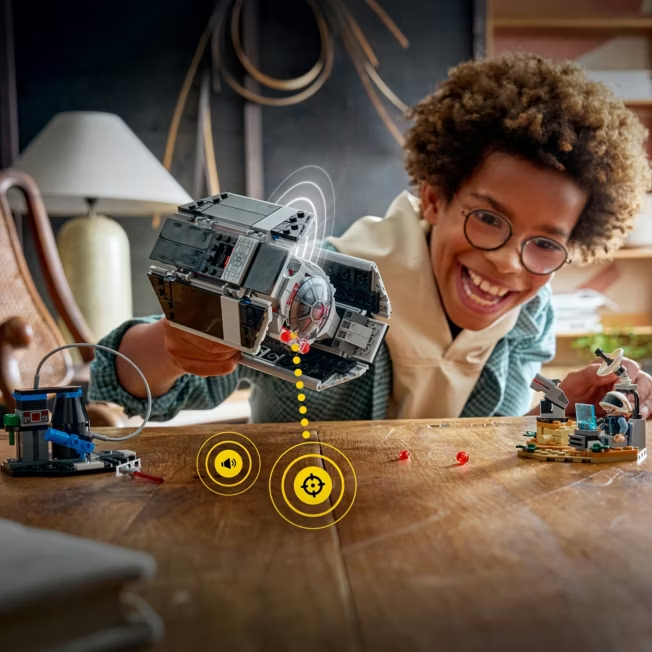
The TIE Fighter, which would traditionally rely entirely on imagination to feel alive, now produces engine sounds as it moves, responds to interactions such as refuelling or repair through colour-based triggers, and reacts to simulated combat scenarios with light and sound feedback that adds a sense of consequence to play.
It is not attempting to replicate a video game or create a fully scripted experience, and that restraint is important, because it keeps the focus on physical interaction rather than replacing it.
Technology that supports play rather than replacing it
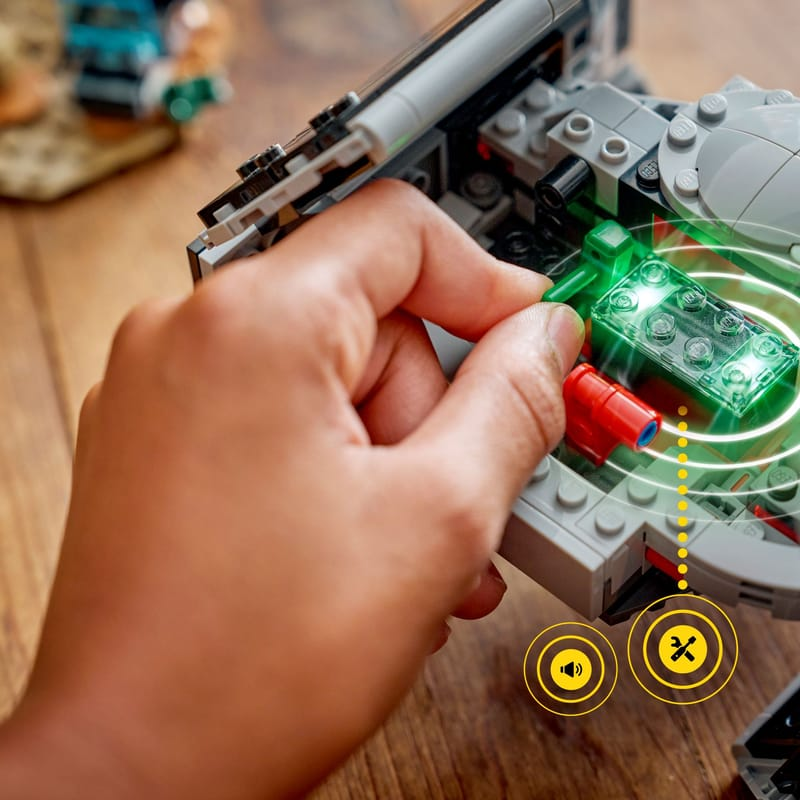
At a technical level, the Smart Brick is far more capable than it initially appears, combining motion sensors, orientation tracking, colour detection, proximity sensing, audio output, lighting, and NFC-based programming into a compact unit that integrates seamlessly into standard Lego builds.
However, what stands out is not the technology itself, but how invisible it feels during use, because the interaction model is entirely physical and intuitive, requiring no direct engagement with menus, apps, or instructions once the system is in place.
The experience unfolds through experimentation, as movement triggers sound, objects influence behaviour, and the presence of specific elements alters how the build responds, creating a feedback loop that encourages curiosity without forcing a specific way to play.
This approach aligns closely with Lego’s core philosophy, allowing the Smart Brick to enhance imagination rather than compete with it.
Where the system feels most natural
The strongest aspect of the Smart Brick is how seamlessly it integrates into actions that already feel natural within Lego play, which is a critical distinction because it avoids introducing friction or requiring users to learn new behaviours.
Flying the TIE Fighter remains fundamentally the same activity, but the addition of responsive sound that adapts to motion introduces a sense of presence that enhances the experience without changing its structure.
Similarly, interactions such as firing, refuelling, or repairing are tied to physical elements within the set, reinforcing the idea that everything is still grounded in the build rather than controlled externally.
This consistency allows the system to remain intuitive, as actions lead to immediate and understandable responses, encouraging continued exploration without the need for explicit guidance.
Physical play remains at the centre
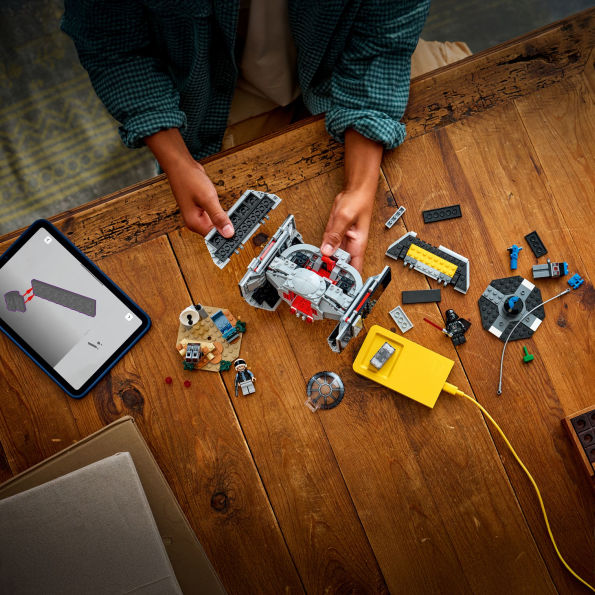
One of the most reassuring aspects of the Smart Brick is that it does not attempt to shift the experience toward screen-based interaction, despite the presence of the LEGO Smart Assist app, which is positioned more as a support tool for setup, updates, and adjustments rather than a central component of play.
This ensures that the primary interaction remains tactile and physical, preserving the hands-on nature of Lego while allowing the technology to operate in the background.
The result is an experience that feels enhanced rather than redirected, maintaining continuity with traditional Lego play while introducing new elements of responsiveness.
Build quality continues to anchor the experience
Even when the Smart features are set aside, the Darth Vader TIE Fighter set stands as a well-executed Lego build, with a structure that is both durable and designed for active use rather than display, which is essential given the interactive nature of the system.
The integration of the Smart Brick is handled in a way that does not disrupt the build, allowing it to be inserted and removed easily without compromising structural integrity, which reflects a thoughtful approach to combining traditional design with new functionality.
This balance ensures that the set remains enjoyable both as a standard Lego model and as part of the Smart Play ecosystem.
A system that feels early, but not unfinished
While the Smart Brick delivers on its core concept, there is a noticeable sense that the system is still in its early stages, particularly in terms of the depth and variety of interactions available within the current sets.
The initial experience is engaging, but it does not take long to begin anticipating additional layers of complexity that are not yet present, such as more varied responses, stronger connections between different elements, and a greater sense of progression within play.
However, this does not undermine the overall experience as much as it highlights the potential for future development, suggesting that the platform has been designed with expansion in mind rather than fully realised at launch.
Practical considerations remain manageable
Battery life, at approximately 45 minutes of active use, is sufficient for typical play sessions but introduces a level of maintenance that differs from traditional Lego pieces, as the Smart Brick requires regular charging to remain functional.
The inclusion of a wireless charging pad simplifies this process, integrating it into the routine of use, but it also reinforces the idea that this is a powered component rather than a passive one.
While this represents a shift from the longevity typically associated with Lego, it is a reasonable trade-off given the functionality being introduced.
Final verdict: a strong foundation with clear room to grow
The Lego Smart Brick, as experienced through the LEGO Star Wars 75421 Darth Vader’s TIE Fighter set, represents a thoughtful and measured step toward integrating responsive technology into the Lego system without compromising its core identity.
By focusing on enhancing physical interaction rather than replacing it, Lego has created a product that feels aligned with its existing philosophy while opening the door to new possibilities.
Although the current implementation does not fully explore the potential of the underlying technology, the foundation is strong, and the direction is clearly defined.
This is not a finished evolution, but it is a promising beginning, one that suggests Lego is approaching the future of play with a level of restraint and understanding that works in its favo