



Hypershell X Ultra review: I strapped robot legs to my body for two weeks. Here’s what happened
At £1,599 this wearable exoskeleton sounds like science fiction. The unsettling part is how quickly it starts to feel normal
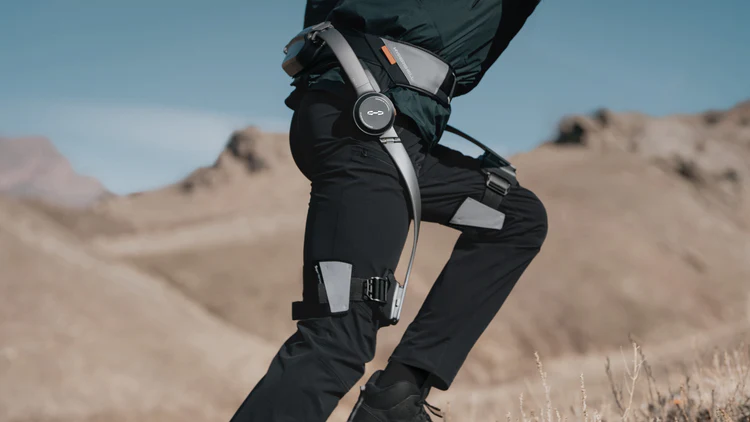
The Hypershell X Ultra is not a product that was supposed to exist yet. Wearable exoskeletons have lived in science fiction, industrial warehouses, and rehabilitation clinics for long enough that the idea of strapping one on for a Sunday hike feels mildly absurd. And yet here we are, and the thing works. A 1.8kg waist-mounted rig with two carbon fibre leg assists genuinely reduces physical exertion by a measurable margin, whether you’re grinding up a hill on a loaded pack, grinding out miles on a bike, or simply trying to keep up with a toddler who operates at a frequency beyond human endurance. At £1,599 it is, without question, a serious investment. Whether it’s a justifiable one depends entirely on who you are and what you do with your weekends. For the right kind of active person, this is one of the most interesting pieces of wearable tech available right now.
Pros
- Measurably reduces exertion: up to 20% less effort walking, up to 39% on a bike
- 1.8kg total weight is impressively light for the hardware involved
- Transparent mode adds zero noticeable resistance when not needed
- Companion app is well-designed with genuinely useful activity detection
- Second battery included in the box
Cons
- £1,599 / $2,000 is a steep ask for most buyers
- Hyper mode drains the battery in under 5km
- IP54 rating is on the cautious side for an outdoor-marketed product
- Charging port is on the device rather than the removable battery pack
- Leg straps require firm tightening to be effective, which takes some getting used to
Quick Specs
| Price | £1,599 / $2,000 |
| Peak power | 1,000W |
| Range | Up to 30km (Eco mode); under 5km (Hyper mode) |
| Weight | 1.8kg / 4.0lb |
| Dimensions (folded) | 430 x 260 x 125mm |
| Connectivity | Bluetooth |
| Water resistance | IP54 |
| Charge time | ~1.5 hours (USB-C) |
| Batteries included | 2 |
| Modes | Transparent, Eco, Hyper, Fitness |
Price & Availability
The Hypershell X Ultra is available now directly through Hypershell’s own website at £1,599 in the UK and $2,000 in the US. There are no configurations to choose between: you get the exoskeleton, a carry case, and, importantly, two batteries in the box. That second battery matters more than it might seem, given how quickly Hyper mode can deplete a single pack. Hypershell sells additional batteries separately if you’re planning extended multi-day trips, though at this price point you’d hope the base kit would carry you through a full day’s activity on Eco mode without drama, and it does.
This is firmly premium territory, sitting in a category with essentially no direct consumer competitors at the same price point. Industrial exoskeletons cost multiples more and aren’t designed for outdoor activity. Rehabilitation devices are medically classified and sold through clinical channels. The X Ultra is an unusual product in an unusual position: the most accessible version of technology that most people have never seriously considered buying. Whether that’s exciting or alarming probably says something about your relationship with the outdoors.
What Even Is This Thing?
Before going any further, it’s worth being precise about what the Hypershell X Ultra does, because the word exoskeleton carries implications that don’t all apply here. This is not an Iron Man suit. It is not moving your legs for you. There is no full-body rig, no powered arm assistance, no sci-fi transformation of what your body can physically achieve.
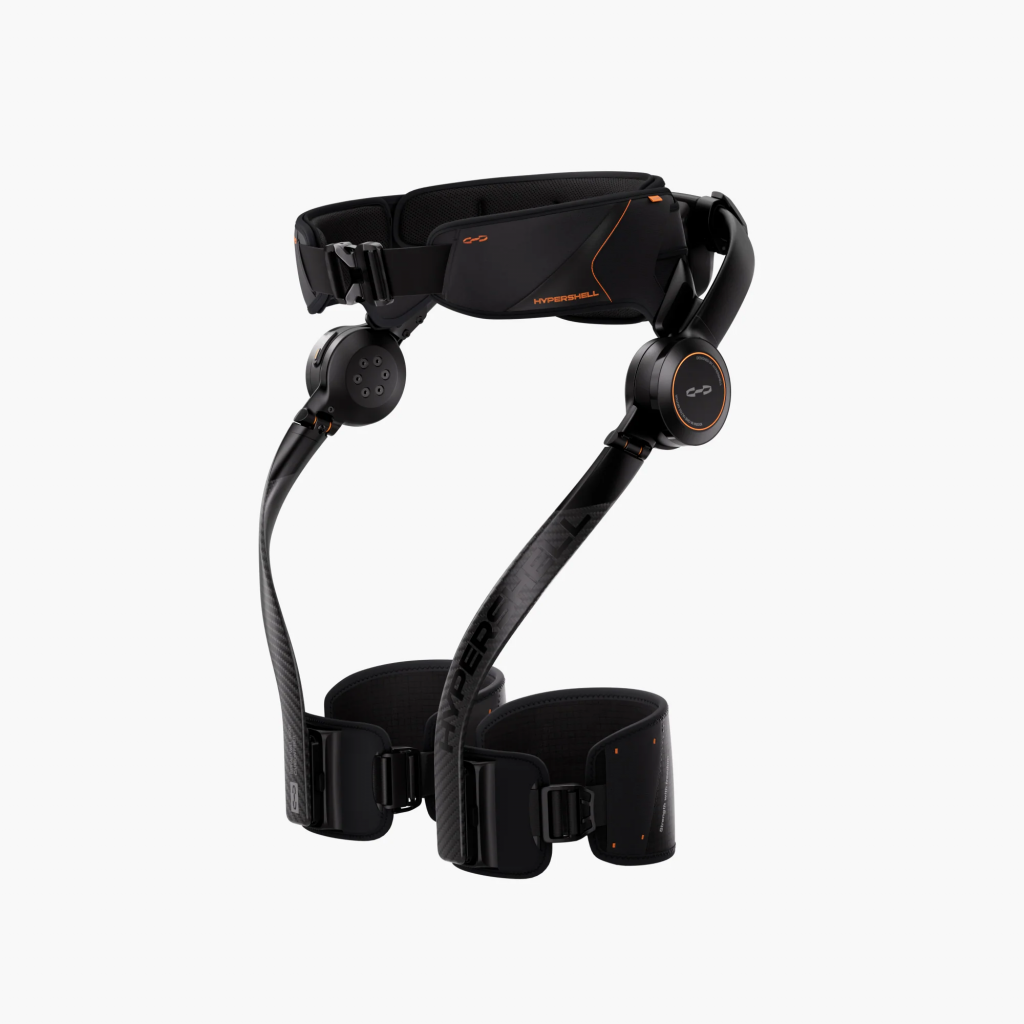
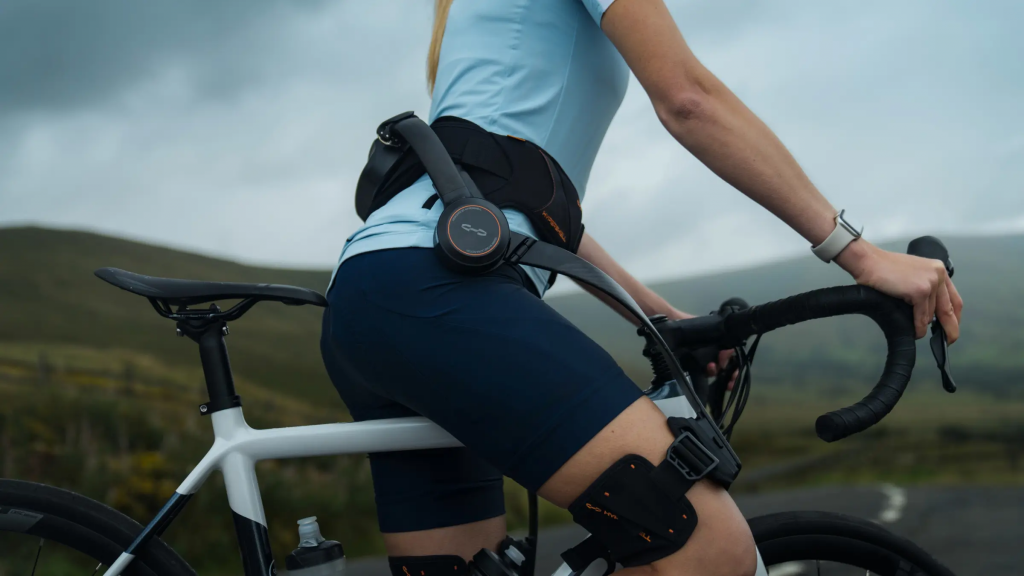
What you actually get is a waist-worn device with a miniaturised motor on each hip, each of which articulates a carbon fibre arm that attaches to your leg just above the knee via elasticated straps. The system reads your movement and responds to it, adding or subtracting force depending on which mode you’ve selected. In Eco mode, it gives a gentle push in the direction you’re already moving. In Hyper mode, that push becomes significantly more pronounced. In Fitness mode, it actively resists your movement to make you work harder. In Transparent mode, it does nothing at all and stays completely out of your way.
The important framing is that you’re still doing most of the work. The X Ultra augments your effort rather than replacing it. For some buyers that will feel like a disappointment. For anyone who has spent the second half of a long hike wondering if their knees are going to see them home, it will feel like exactly what was advertised.
The First Time You Put It On
Unboxing the X Ultra, the first reaction is relief. It’s lighter than expected, much lighter, and the carry case is well-formed enough that nothing rattles or shifts in transit. The titanium alloy frame and carbon fibre arms look serious without being intimidating, and the predominantly black colourway is understated given the technology involved.
Fitting it takes longer the first time than it will ever take again. The waist section needs to sit in roughly the same position as a backpack hip belt, high enough on the hips that the leg arms can articulate properly. The carbon fibre arms extend downward from each hip motor and clip to elasticated straps just above the knee. Those straps need to be cinched firmly, tighter than feels instinctively comfortable, for the assist to actually transmit into the leg rather than push against air. The companion app walks through the setup with clear illustrated instructions, and after a few sessions the whole process takes a few minutes at most.
Once it’s on and adjusted, you straighten up, take a step, and wait for something dramatic to happen. Nothing dramatic happens, which is exactly right. In Eco mode the assistance is subtle enough that it reads less as robotic intervention and more as the vague but persistent sense that you’re moving slightly more easily than you ought to be. You end up looking down at your legs and wondering what’s different, and what’s different is that two miniaturised motors are quietly pushing you forward.
That subtlety is, depending on your expectations, either the product’s greatest strength or a mild anticlimax. If you were expecting to feel bionic, you won’t. If you were hoping to feel less tired at the end of a long day, you will.
Two Weeks on the Trail, the Road, and Everywhere Else

Testing the X Ultra across two weeks covered road cycling, running in a local park, and several longer hikes with a loaded pack. The headline finding is consistent across all of them: the assistance is real, it shows up in physiological data, and the legs feel meaningfully better at the end of sessions than they do without it.
Hypershell claims up to 20% reduction in exertion while walking and up to 39% on a bike. The cycling figure is the one that lands hardest in real-world use, because it most closely mirrors what an e-bike does for a rider. On a familiar route with a habitual testing hill, the X Ultra in Eco mode produced a noticeably different experience than the same route without it. Not effortless, but notably more manageable. The hill didn’t disappear. The usual point of peak suffering on the gradient arrived later, was less severe, and required less recovery time at the top. After a two-hour ride that would normally leave the legs meaningfully fatigued, there was considerably more left in the tank. That’s a concrete and useful benefit.
Hiking with a loaded pack is where the product’s proposition feels most coherent. The cumulative toll of carrying weight uphill over several hours is exactly the use case the X Ultra was designed for, and the reduction in leg fatigue over a long day is noticeable. Muscle soreness the following day, used as an informal metric across multiple hiking sessions, was consistently lower than comparable sessions without the rig. Carrying a heavy pack of camping gear that would normally prompt a rethink about route ambition felt more manageable with the X Ultra on. That’s not a small thing if you spend serious time in the hills.
Eco mode is the right default for almost all situations. The assistance is helpful without feeling artificial, and range holds up well across a full day of mixed activity. Hyper mode is a different story. The push from the motors in Hyper is strong enough to be genuinely startling the first time it engages at full intensity, and the energy expenditure on the battery is correspondingly punishing. Under 5km of range in Hyper mode is not a misprint, and it shapes how you deploy it: short, specific bursts on demanding sections rather than a sustained operating mode. The second battery handles the shortfall on longer days, though swapping batteries mid-hike with cold hands is not a refined experience.
Fitness mode, which resists your movement to increase training load, works as described. The resistance is real and the training effect is measurable. It’s also the least compelling reason to spend £1,599. Resistance bands and leg weights achieve a comparable outcome for a fraction of the cost. The X Ultra earns its place as an assist and augmentation device. As a workout tool, it’s a secondary feature.
Running is the one activity where the benefit feels most marginal. The X Ultra detects the motion correctly and adjusts power delivery, but the biomechanics of running, the shorter, faster stride cycles compared to hiking or cycling, mean the motors have less time to deliver meaningful assistance with each movement. It’s not a negative experience, but it’s the weakest of the use cases tested.
The App: Better Than It Needs to Be
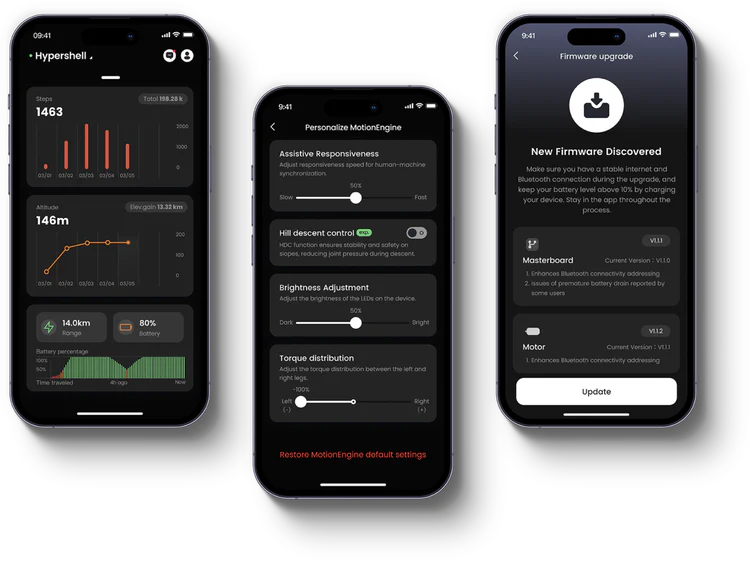
Wearable tech companion apps have a well-earned poor reputation, and it would have been easy for Hypershell to phone this one in. They didn’t. The pairing process is quick and reliable. The mode-switching interface is clean. The setup walkthrough is illustrated clearly enough that you don’t need to re-read it after the first session.
Within each mode there’s a manual assist slider for fine-tuning intensity, a 30-second boost function for maximum output on demand, and a range of deeper settings that reveal genuine engineering care. A hill descent mode adds stability assistance on downward slopes. A torque distribution slider lets you adjust the balance between left and right leg, with obvious applications for anyone managing an asymmetric weakness or returning from injury. Hypershell is careful not to position the X Ultra as a medical device, but the thoughtfulness of these settings suggests they know exactly who will find them useful.
The activity detection feature uses machine learning to identify what you’re doing and adjusts power delivery accordingly. It correctly recognised the transition from walking to cycling during testing and recalibrated without prompting, accounting for the different range of motion pedalling requires. The battery indicator displayed in the app was consistently accurate, which is a rarer quality in wearable tech than it should be.
The Bits That Need Work

Two issues recur throughout two weeks of testing that a future version should address. The first is the charging port location. It sits on the device body rather than on the battery pack, which means you can’t simply pull the battery and plug it in at a desk. The whole assembled rig needs to come to the power socket. On a long day’s hiking with a lunch stop, this is manageable. On any other occasion, it’s unnecessarily awkward. A USB-C port on the battery pack itself would be a straightforward and meaningful improvement.
The second is the IP54 water resistance rating. For a product sold explicitly for outdoor use by hikers, mountaineers, and cyclists, IP54 is a cautious specification. It handles light rain without complaint, and in testing it survived an unplanned downpour without lasting damage beyond damp padding. But serious outdoor activity in the UK regularly means sustained heavy rain, and the rating doesn’t fully account for that. IP67 or higher would make the X Ultra genuinely all-weather rather than mostly all-weather.
Neither of these is a reason not to buy the current version. Both are reasons to hope the second generation arrives sooner rather than later.
The Verdict: Sci-Fi That Actually Works

Two weeks ago, the idea of writing that a consumer exoskeleton is a reasonable purchase recommendation would have felt absurd. Having worn the Hypershell X Ultra across hiking, cycling, and running in that time, it no longer does. The technology works. The engineering is impressive. The app is good. The weight is genuinely astonishing for what the hardware contains. And the core promise, that strapping this thing on will make outdoor activity measurably less demanding on your body, holds up across repeated real-world use.
The price is the honest barrier. At £1,599 the HYPERSHELL X Ultra is asking for serious money from a serious outdoor enthusiast, and the conversation about whether that money is better spent elsewhere is legitimate. But there is nothing else available at any price that does what this does. The category has no direct consumer competitors. If the capability matters to you, the X Ultra is currently the only option, and it’s a better product than a first-generation device in a brand-new category has any right to be.
The IP54 rating and the Hyper mode battery limitation are real constraints. The charging port design is a frustration. The leg straps demand patience at first. None of these things change the fundamental achievement of a 1.8kg wearable that demonstrably reduces how hard your body works on the hills you love.
In two weeks, the X Ultra went from novelty to habit faster than almost any piece of outdoor kit tested in recent memory. That, more than any spec sheet figure, is the most useful thing to know about it.
Buy it if: You spend serious time outdoors carrying weight, you’re returning to activity after injury, or you want to extend your range and reduce physical toll without changing what you do or how you do it, and the budget is there.
Skip it if: Your outdoor activity is casual or occasional, you’re primarily interested in resistance training, or £1,599 would be better directed at other kit upgrades with broader day-to-day impact.