



Samsung at CES 2026: Bigger Screens, Smarter Homes, and AI Everywhere You Look
If CES 2026 needed a starting pistol, Samsung fired it: loudly, confidently, and with a whole lot of AI. The company’s first press conference of the year was less about surprise reveals and more about planting a flag: this is what Samsung thinks the future looks like, and yes, it’s powered by artificial intelligence whether you asked for it or not.
From ultra-premium TVs and sculptural speakers to projectors, soundbars, and appliances that increasingly think for themselves, Samsung’s “First Look” presentation set the tone for the week. Some of what we saw had already been teased ahead of the show. Some of it felt more conceptual than practical. And some of it, particularly in the display space, was genuinely jaw-dropping.
Here’s everything Samsung announced at CES 2026, and what actually stood out once the lights dimmed and the demos began.
The 130-inch Micro RGB TV: spectacular, excessive, unforgettable
Samsung clearly wanted to make a statement, and it did so with a TV that looks less like consumer electronics and more like an art installation.
The star of the show was a previously undisclosed 130-inch Micro RGB TV, mounted inside a massive metal easel frame with embedded speakers. It’s one of the most visually striking TVs Samsung has ever built: towering, bold, and completely unapologetic about its excess.
Is it practical? Not remotely.
Is it coming to stores soon? Probably not.
Will it be obscenely expensive if it does? Almost certainly.
But as a vision piece, it worked. It communicated Samsung’s ambition for Micro RGB technology better than any spec sheet ever could.
Micro RGB, for context, uses microscopic red, green, and blue LEDs as individual light sources, allowing for extreme brightness, precision colour control, and, according to Samsung, full 100% coverage of the Rec.2020 colour space. That’s something even top-tier OLED panels can’t quite achieve.
Micro RGB TVs for (slightly) more realistic humans
While the 130-inch behemoth felt closer to a museum piece, Samsung’s broader Micro RGB TV lineup is edging toward something that resembles reality.
Last year’s first Micro RGB TV was a 115-inch proof of concept priced at a stomach-churning $30,000. This year, Samsung is expanding the range dramatically, with models coming in 55-, 65-, and 75-inch sizes — the kind of dimensions people actually buy.
Larger options aren’t disappearing either. Samsung confirmed 85-, 100-, and 115-inch models are also on the way. Pricing hasn’t been announced yet, but it’s safe to assume the smaller models will land well below last year’s $30K experiment.
The message here is clear: Micro RGB isn’t a science project anymore. Samsung wants it to be a pillar of its ultra-premium TV strategy.
Music Studio speakers: audio as interior design

Samsung’s Music Studio speakers may not be brand-new announcements, but CES was the first chance to see and hear them properly, and design is absolutely the point.
The Music Studio 5 and Music Studio 7 are wireless speakers supporting Bluetooth and Wi-Fi, but they’re clearly designed to be seen as much as heard.
The Studio 5 features a four-inch woofer paired with dual tweeters. The Studio 7 steps things up significantly with a 3.1.1 configuration and speakers firing upward, forward, left, and right to create a more immersive, room-filling sound.
Samsung talks about “3D audio,” but in practice the appeal is how these speakers blend into modern living spaces without screaming “tech.” They feel closer to furniture than hardware: intentional, sculptural, and lifestyle-first.
Freestyle+ projector: smaller, smarter, still trying to win hearts
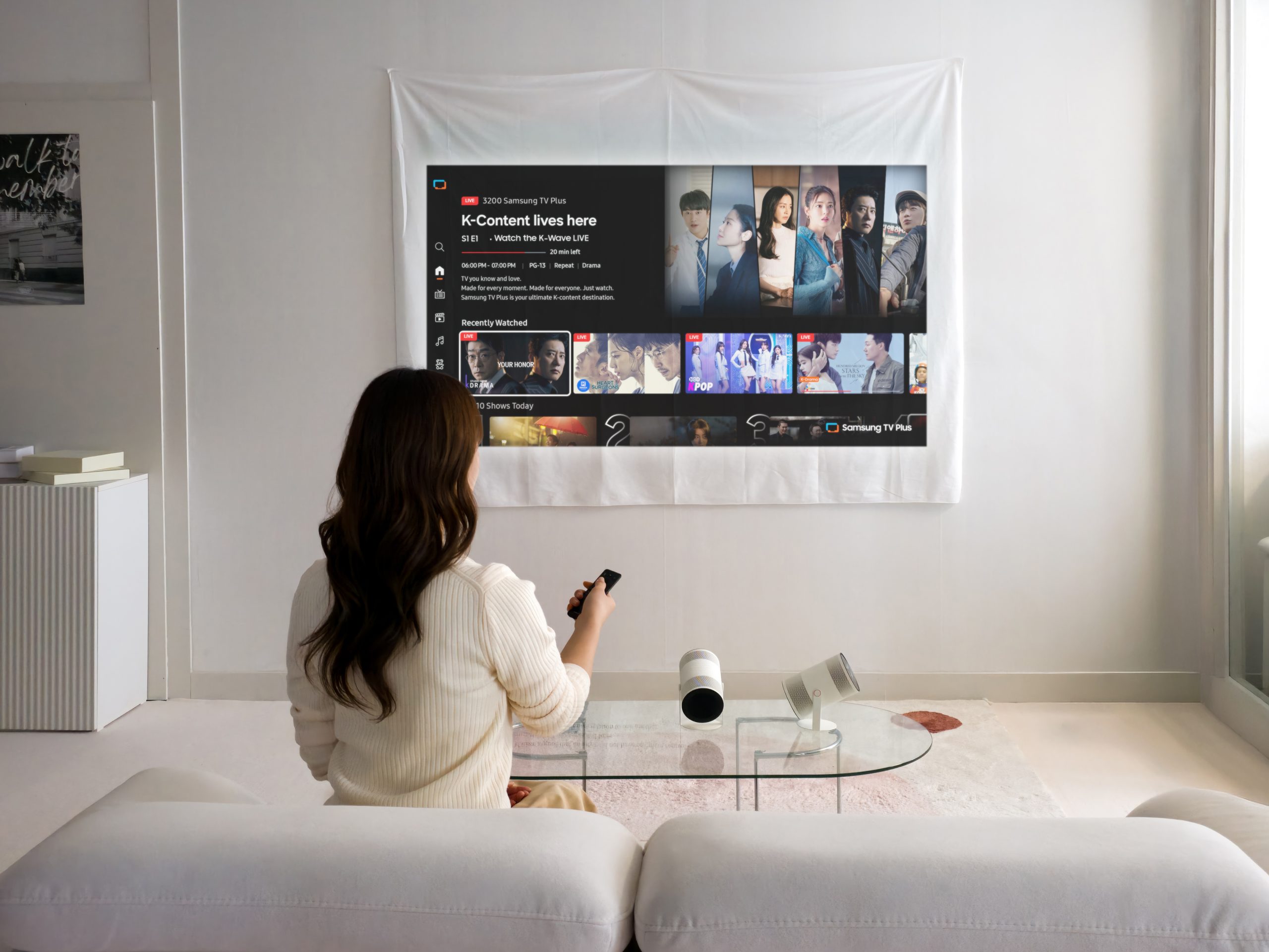
Samsung isn’t done chasing the portable projector dream.
The new Freestyle+ builds on previous Freestyle models with a brighter image and, unsurprisingly, more AI. It’s still compact, still designed to be moved easily between rooms, and still aimed at people who want flexible viewing rather than a fixed home cinema setup.
According to Samsung, the Freestyle+ uses AI to analyse its environment and optimise both picture and content automatically: adjusting brightness, colour, and framing depending on where and how it’s placed.
It’s not a dramatic reinvention, but it’s a steady refinement of a product line Samsung clearly believes in.
A soundbar for people who hate subwoofers
One of the more interesting finds wasn’t even mentioned on stage.
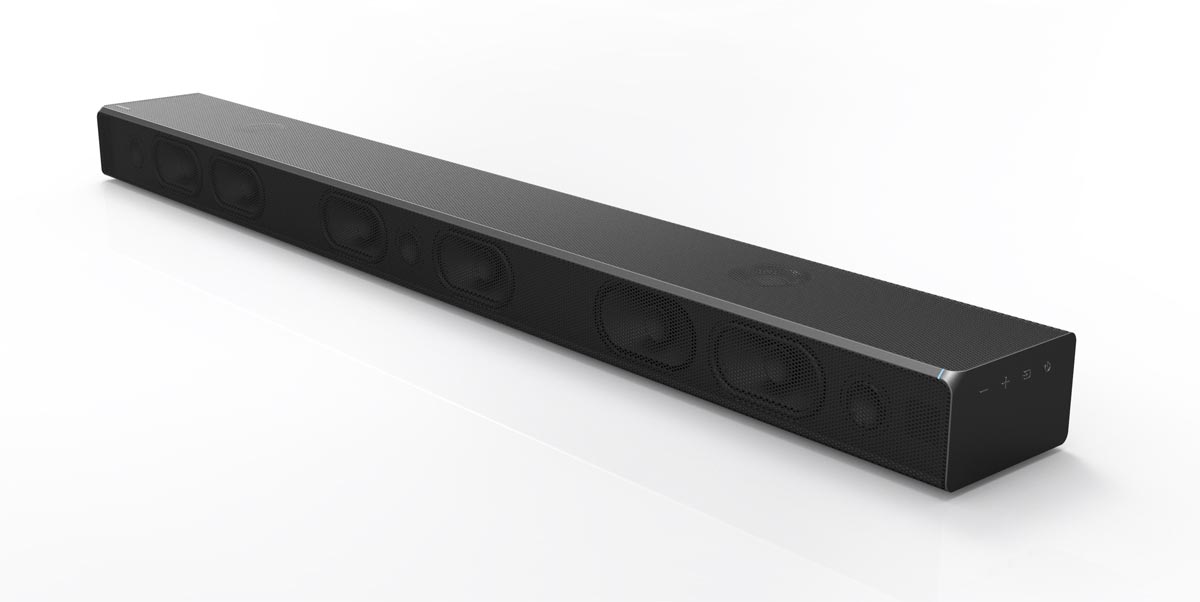
Tucked away in the demo area was the Samsung HW-QS90H soundbar: a new take on the company’s popular QS90 line, designed specifically for people who don’t want a separate subwoofer cluttering their living room.
This is an all-in-one 7.1.2 soundbar with 13 drivers, including four built-in woofers forming what Samsung calls its “Quad Bass Woofer system.” The idea is simple: deliver serious low-end punch without asking users to hide a black box in the corner.
Early impressions suggest Samsung may have actually pulled this off, making it one of the more quietly compelling home audio products at the show.
And then… AI. Everywhere. All the time.
Once the hardware announcements wrapped up, the rest of Samsung’s presentation shifted into full AI evangelism mode.
AI-powered demos included:
- Muting commentators during live sports broadcasts
- Following recipes directly on fridge door displays
- Optimising washing machine cycles automatically
- Enhancing picture and sound in real time across TVs
Some of these uses felt genuinely helpful. Others felt like AI for the sake of AI, features that exist because they can, not necessarily because they solve urgent problems.
Samsung’s message, however, was unmistakable: AI isn’t a feature anymore. It’s the connective tissue across its entire ecosystem.
Gaming monitors and displays quietly flexing
While TVs stole the spotlight, Samsung also confirmed updates to its gaming monitor lineup, including a new Odyssey display with a 32-inch 6K panel and glasses-free 3D technology.
Details were light during the press conference, but it’s clear Samsung continues to push aggressively into high-end gaming displays, especially where resolution and immersive tech are concerned.
Final thoughts: Samsung sets the tone, loudly and confidently
Samsung came to CES 2026 to surprise and dominate the conversation.
This wasn’t a show about wild left-field experiments. It was about refinement, scale, and doubling down on ideas Samsung already believes will define the next few years: massive displays, design-led audio, portable screens, and AI woven into absolutely everything.
Not all of it will land. Some of it will remain aspirational. But as opening statements go, this was a powerful one.